Tutorial 4: Forces, Free Body Diagrams, Newton's 3rd Law
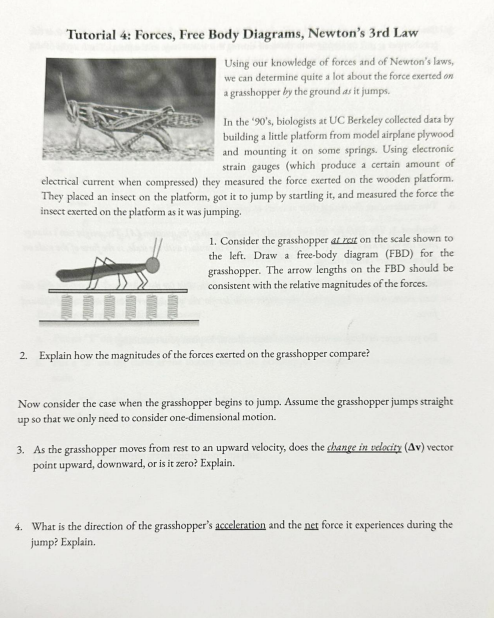
Using our knowledge of forces and of Newton's laws,
we can determine quite a lot about the force exerted on
a grasshopper by the ground as it jumps.
In the '90's, biologists at UC Berkeley collected data by
building a little platform from model airplane plywood
and mounting it on some springs. Using electronic
strain gauges (which produce a certain amount of
electrical current when compressed) they measured the force exerted on the wooden platform.
They placed an insect on the platform, got it to jump by startling it, and measured the force the
insect exerted on the platform as it was jumping.
1. Consider the grasshopper at rest on the scale shown to
the left. Draw a free-body diagram (FBD) for the
grasshopper. The arrow lengths on the FBD should be
consistent with the relative magnitudes of the forces.
2. Explain how the magnitudes of the forces exerted on the grasshopper compare?
Now consider the case when the grasshopper begins to jump. Assume the grasshopper jumps straight
up so that we only need to consider one-dimensional motion.
3. As the grasshopper moves from rest to an upward velocity, does the change in velocity (Av) vector
point upward, downward, or is it zero? Explain.
4. What is the direction of the grasshopper's acceleration and the net force it experiences during the
jump? Explain./n5. Draw a free-body diagram for the grasshopper during the initial stages of the jump. Note that the
grasshopper is still in contact with the scale during this initial stage of the jump. The lengths of the
arrows on your FBD should be consistent with the relative magnitude of the forces.
6. Two students are discussing their answers to question (E):
Student 1: The FBD for (E) looks exactly the same as that for question (A). The weight can't change
since the mass didn't change. The grasshopper is still in contact with the scale, so the force of the scale on
the grasshopper cannot change.
Student 2: You're right that the weight must be the same. But for the FBD in (E), the force that the
scale exerts must be bigger than the weight in order for the grasshopper to experience a net upward
force.
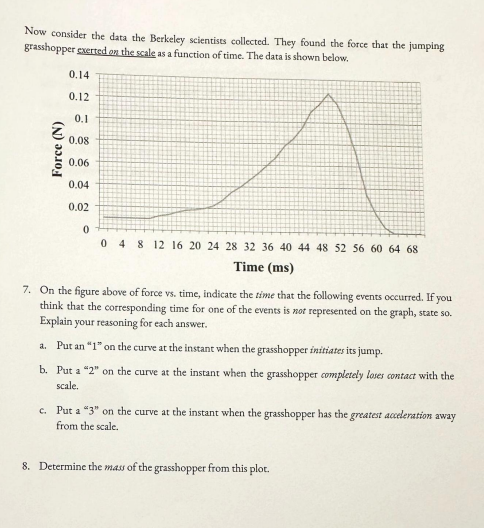
Do you agree or disagree with either of the students? Explain your reasoning./nNow consider the data the Berkeley scientists collected. They found the force that the jumping
grasshopper exerted on the scale as a function of time. The data is shown below.
Force (N)
0.14
0.12
0.1
0.08
0.06
0.04
0.02
0
0 4 8 12 16 20 24 28 32 36 40 44 48 52 56 60 64 68
Time (ms)
7. On the figure above of force vs. time, indicate the time that the following events occurred. If you
think that the corresponding time for one of the events is not represented on the graph, state so.
Explain your reasoning for each answer.
a. Put an "1" on the curve at the instant when the grasshopper initiates its jump.
b. Put a "2" on the curve at the instant when the grasshopper completely loses contact with the
scale.
c. Put a "3" on the curve at the instant when the grasshopper has the greatest acceleration away
from the scale.
8. Determine the mass of the grasshopper from this plot.

Download app now or scan to get app



Download app now or scan to get app
