1. Using the timer on the upper right, record the time for each mass to complete 10 cycles of motion. If you have forgotten the meaning of periodic properties, you
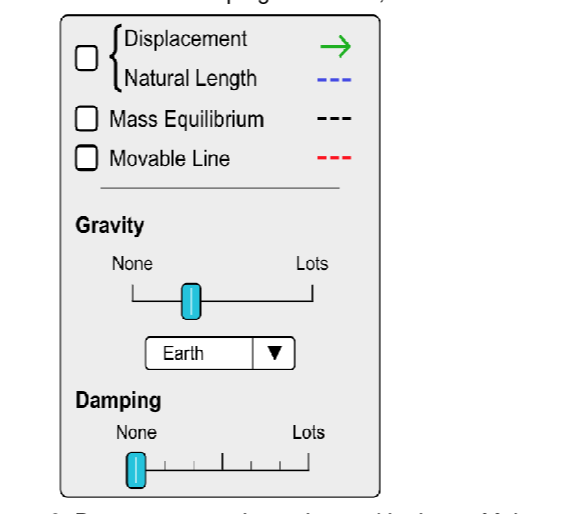
can refer to the text or to this webpage. Record your answers in the space below. Then calculate the time for one period of each mass. Finally calculate the frequency of each mass. Make sure to clearly label your values. You may have noticed that there is a connection between the mass on the spring and time it takes to go through one cycle of motion. Refer to your textbook for the equation that would enable you to calculate the spring constant. 2. Using the proper equation, calculate the spring constant from each of the springs. Then calculate your average spring constant between the two springs. Write out all steps and the final answers below. 3. You should have used two different masses in steps 1 and 2. Now estimate the period of one swing from the third mass, using the spring constant and equation in #2. Write out your work and the final answer below. Now switch to the vector mode of the simulation, like in the picture below: 4. Drag a mass to the spring on the left and click the acceleration and force vectors to be visible.Summarize the appearance of the two vectors below. 5. Now refresh the simulator, drag a mass to the left spring, and click only the velocity vector to display. Knowing the connection between velocity and kinetic energy, make a sketch of the system below, and label where the velocity is maximum and minimum. Also, label where you predict the kinetic energy to be maximum and minimum. Now click on the energy tab on the bottom of the screen, like shown here: Then set the damping to be zero, as shown here: 6. Drag a mass to the spring and let it run. Make a note of where the bar of kinetic energy on the left is highest and lowest. Sketch the spring, showing where the kinetic energy is highest and lowest, and then comment as to whether your predication from #5 was correct. Now that you have some experience in how this simulator works, it is time to let you loose! The following set of questions will be more free form. You may need to explain how you used the simulator to prove your answer. Keep in mind that with open ended questions, you may have more than one way to answer the question. Part of your grade on the next few questions will come from how succinctly and correctly you answer the questions. 7. By investigation, determine when the Elastic Potential Energy is zero. Make sure you test your idea with several masses and vary the stiffness of the spring. Write down how you determined the zero location(s) and explain why the position for zero makes sense. 8. Why did you need to use varying conditions (mass, spring, etc.) in #7? 9. Put a mass on a spring and observe the total energy graph as it oscillates. Pay attention to details of the energy distribution. Think about why the energy is distributed differently for several situations. For example: When is there only kinetic energy? What makes the elastic energy increase? Test your ideas with varying conditions; write down your observations and conclusions. 10. Suppose you have a skater going back and forth on a ramp like this. How does his energy distribution as he rides compare and contrast to that of the mass moving on a spring? You can run the Energy Skate Park simulation to test your ideas. First take a 1 kg mass and lift it one meter in the air. If you are not a fan of lifting weights, you may have a friend do this for you. 11. After putting the 1 kg mass down and calculate how much work you did in lifting the weight.Write your work and answer below. 12. Now lift the 1 kg mass up one meter in the air, repeatedly, and time how long it takes you to do so with a timer or cell phone. Write out the time below. 13. Assuming that you total work you did by raising the mass ten times is cumulative. How much work did you do in raising the mass upwards ten times? Write out your work and final answer below. 14. Power is something you may have heard a lot about in buying light bulbs, or paying your electricity bill. The equation for power is Power (Watts) = Energy / Time. Using this concept,calculate how much power you generated lifting the mass ten times in the amount of time you measured in #12. 15. Assuming that a light bulb requires 40 Watts of constant power to run, how long would you be able to run a 40W light bulb with the exercise you have done? As you can see from #15, the amount of power a light bulb requires is quite significant. Knowing that a 40W light bulb is one of the fainter light sources you may use at home, you may take a moment to turn off lights you are not using. Each light bulb requires an entire workout to stay on,for a significant portion of time!