Aim
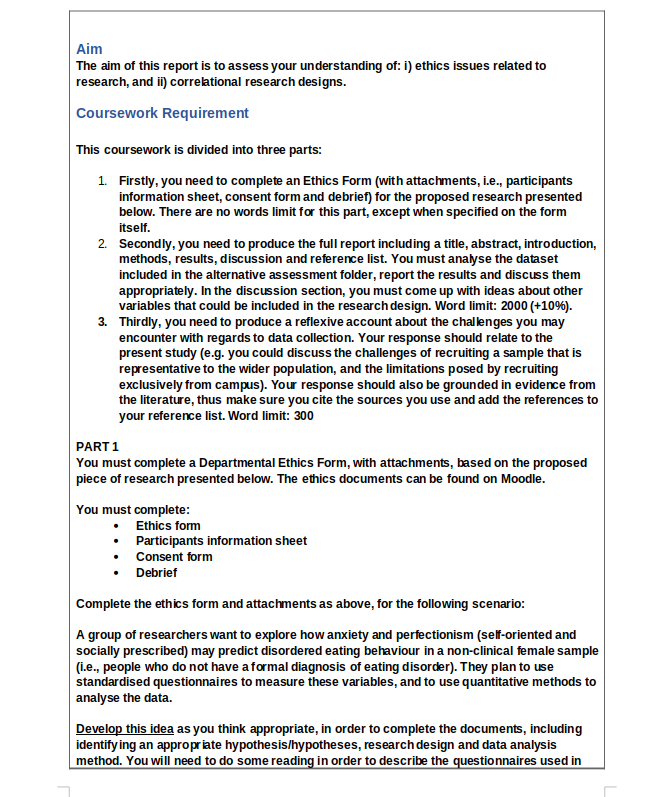
The aim of this report is to assess your understanding of: i) ethics issues related to
research, and ii) correlational research designs.
Coursework Requirement
This coursework is divided into three parts:
1. Firstly, you need to complete an Ethics Form (with attachments, i.e., participants
information sheet, consent form and debrief) for the proposed research presented
below. There are no words limit for this part, except when specified on the form
itself.
2. Secondly, you need to produce the full report including a title, abstract, introduction,
methods, results, discussion and reference list. You must analyse the dataset
included in the alternative assessment folder, report the results and discuss them
appropriately. In the discussion section, you must come up with ideas about other
variables that could be included in the research design. Word limit: 2000 (+10%).
3. Thirdly, you need to produce a reflexive account about the challenges you may
encounter with regards to data collection. Your response should relate to the
present study (e.g. you could discuss the challenges of recruiting a sample that is
representative to the wider population, and the limitations posed by recruiting
exclusively from campus). Your response should also be grounded in evidence from
the literature, thus make sure you cite the sources you use and add the references to
your reference list. Word limit: 300
PART 1
You must complete a Departmental Ethics Form, with attachments, based on the proposed
piece of research presented below. The ethics documents can be found on Moodle.
You must complete:
• Ethics form
Participants information sheet
Consent form
Debrief
Complete the ethics form and attachments as above, for the following scenario:
A group of researchers want to explore how anxiety and perfectionism (self-oriented and
socially prescribed) may predict disordered eating behaviour in a non-clinical female sample
(i.e., people who do not have a formal diagnosis of eating disorder). They plan to use
standardised questionnaires to measure these variables, and to use quantitative methods to
analyse the data.
Develop this idea as you think appropriate, in order to complete the documents, including
identifying an appropriate hypothesis/hypotheses, research design and data analysis
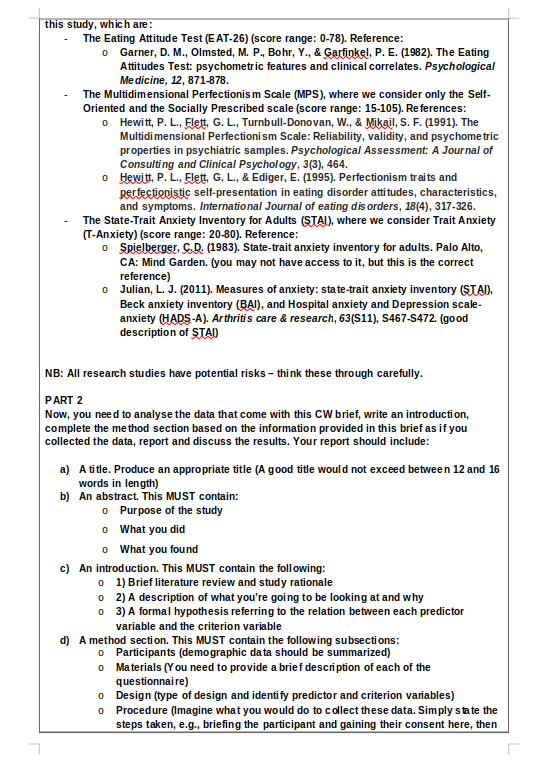
method. You will need to do some reading in order to describe the questionnaires used in/nthis study, which are:
The Eating Attitude Test (EAT-26) (score range: 0-78). Reference:
o Garner, D. M., Olmsted, M. P., Bohr, Y., & Garfinkel, P. E. (1982). The Eating
Attitudes Test: psychometric features and clinical correlates. Psychological
Medicine, 12, 871-878.
The Multidimensional Perfectionis m Scale (MPS), where we consider only the Self-
Oriented and the Socially Prescribed scale (score range: 15-105). References:
o Hewitt, P. L., Flett, G. L., Turnbull-Donovan, W., & Mikail, S. F. (1991). The
Multidimensional Perfectionism Scale: Reliability, validity, and psychometric
properties in psychiatric samples. Psychological Assessment: A Journal of
Consulting and Clinical Psychology, 3(3), 464.
o Hewitt, P. L., Flett, G. L., & Ediger, E. (1995). Perfectionism traits and
perfectionistic self-presentation in eating disorder attitudes, characteristics,
and symptoms. International Journal of eating disorders, 18(4), 317-326.
The State-Trait Anxiety Inventory for Adults (STAI), where we consider Trait Anxiety
(T-Anxiety) (score range: 20-80). Reference:
o Spielberger, C.D. (1983). State-trait anxiety inventory for adults. Palo Alto,
CA: Mind Garden. (you may not have access to it, but this is the correct
reference)
o Julian, L. J. (2011). Measures of anxiety: state-trait anxiety inventory (STAI),
Beck anxiety inventory (BAI), and Hospital anxiety and Depression scale-
anxiety (HADS-A). Arthritis care & research, 63(S11), S467-S472. (good
description of STAI)
NB: All research studies have potential risks - think these through carefully.
PART 2
Now, you need to analyse the data that come with this CW brief, write an introduction,
complete the method section based on the information provided in this brief as if you
collected the data, report and discuss the results. Your report should include:
a) A title. Produce an appropriate title (A good title would not exceed between 12 and 16
words in length)
b) An abstract. This MUST contain:
o Purpose of the study
o What you did
o What you found
c) An introduction. This MUST contain the following:
o 1) Brief literature review and study rationale
o 2) A description of what you're going to be looking at and why
o
3) A formal hypothesis referring to the relation between each predictor
variable and the criterion variable
d) A method section. This MUST contain the following subsections:
o Participants (demographic data should be summarized)
o Materials (You need to provide a brief description of each of the
questionnaire)
o Design (type of design and identify predictor and criterion variables)
o Procedure (Imagine what you would do to collect these data. Simply state the
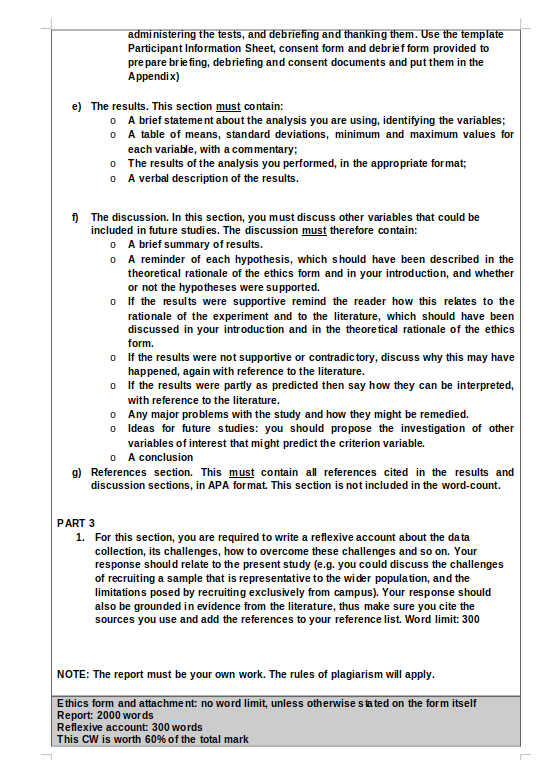
steps taken, e.g., briefing the participant and gaining their consent here, then/ne) The results. This section must contain:
o
o
administering the tests, and debriefing and thanking them. Use the template
Participant Information Sheet, consent form and debrief form provided to
pre pare briefing, debriefing and consent documents and put them in the
Appendix)
A brief statement about the analysis you are using, identifying the variables;
A table of means, standard deviations, minimum and maximum values for
each variable, with a commentary;
o The results of the analysis you performed, in the appropriate format;
o A verbal description of the results.
f) The discussion. In this section, you must discuss other variables that could be
included in future studies. The discussion must therefore contain:
o A brief summary of results.
o
A reminder of each hypothesis, which should have been described in the
theoretical rationale of the ethics form and in your introduction, and whether
or not the hypotheses were supported.
o If the results were supportive remind the reader how this relates to the
rationale of the experiment and to the literature, which should have been
discussed in your introduction and in the theoretical rationale of the ethics
form.
o
If the results were not supportive or contradictory, discuss why this may have
happened, again with reference to the literature.
o
If the results were partly as predicted then say how they can be interpreted,
with reference to the literature.
Any major problems with the study and how they might be remedied.
o
o
Ideas for future studies: you should propose the investigation of other
variables of interest that might predict the criterion variable.
0 A conclusion
g) References section. This must contain all references cited in the results and
discussion sections, in APA format. This section is not included in the word-count.
PART 3
1. For this section, you are required to write a reflexive account about the data
collection, its challenges, how to overcome these challenges and so on. Your
response should relate to the present study (e.g. you could discuss the challenges
of recruiting a sample that is representative to the wider population, and the
limitations posed by recruiting exclusively from campus). Your response should
also be grounded in evidence from the literature, thus make sure you cite the
sources you use and add the references to your reference list. Word limit: 300
NOTE: The report must be your own work. The rules of plagiarism will apply.
Ethics form and attachment: no word limit, unless otherwise stated on the form itself
Report: 2000 words
Reflexive account: 300 words
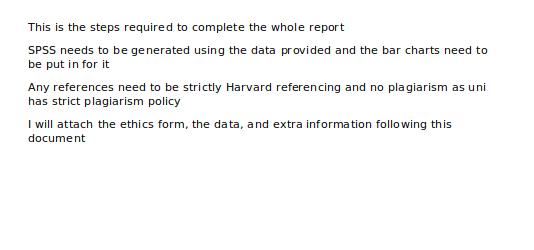
This CW is worth 60% of the total mark/nThis is the steps required to complete the whole report
SPSS needs to be generated using the data provided and the bar charts need to
be put in for it
Any references need to be strictly Harvard referencing and no plagiarism as uni
has strict plagiarism policy
I will attach the ethics form, the data, and extra information following this
document