Assignment Instructions - Part A
This is an individual report.
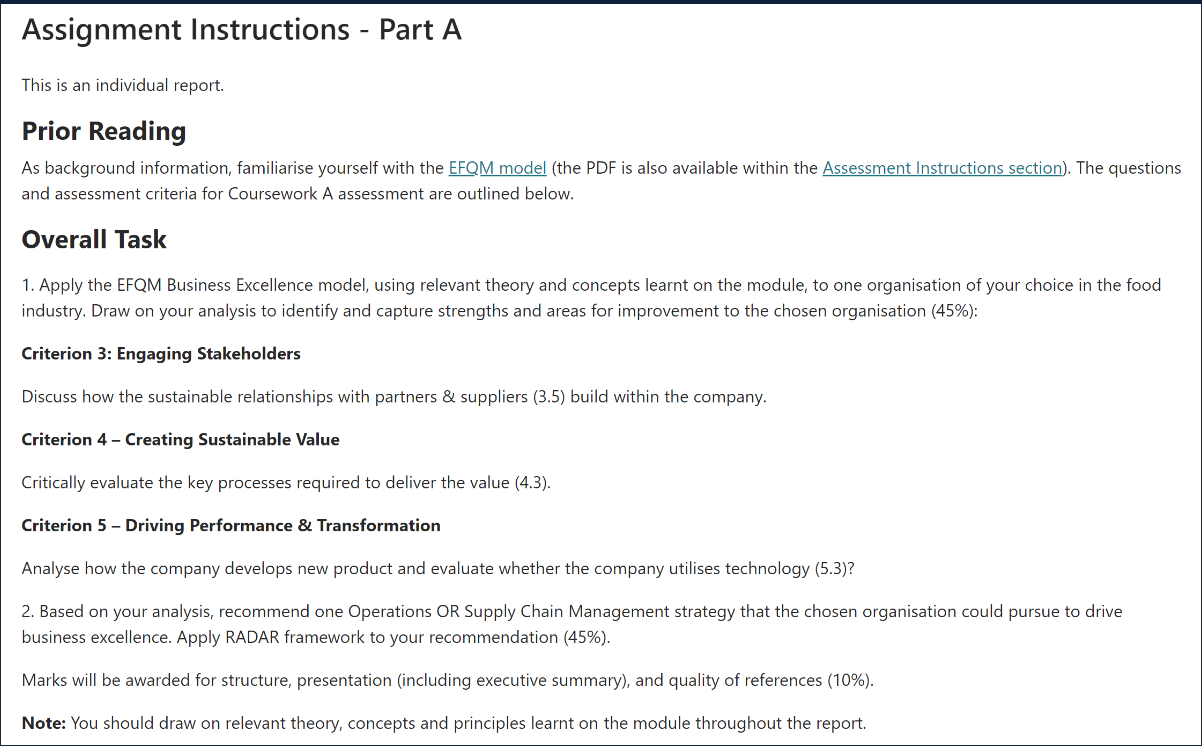
Prior Reading
As background information, familiarise yourself with the EFQM model (the PDF is also available within the Assessment Instructions section). The questions
and assessment criteria for Coursework A assessment are outlined below.
Overall Task
1. Apply the EFQM Business Excellence model, using relevant theory and concepts learnt on the module, to one organisation of your choice in the food
industry. Draw on your analysis to identify and capture strengths and areas for improvement to the chosen organisation (45%):
Criterion 3: Engaging Stakeholders
Discuss how the sustainable relationships with partners & suppliers (3.5) build within the company.
Criterion 4 - Creating Sustainable Value
Critically evaluate the key processes required to deliver the value (4.3).
Criterion 5 - Driving Performance & Transformation
Analyse how the company develops new product and evaluate whether the company utilises technology (5.3)?
2. Based on your analysis, recommend one Operations OR Supply Chain Management strategy that the chosen organisation could pursue to drive
business excellence. Apply RADAR framework to your recommendation (45%).
Marks will be awarded for structure, presentation (including executive summary), and quality of references (10%).
Note: You should draw on relevant theory, concepts and principles learnt on the module throughout the report./nSome advice on developing your strategy in Q2
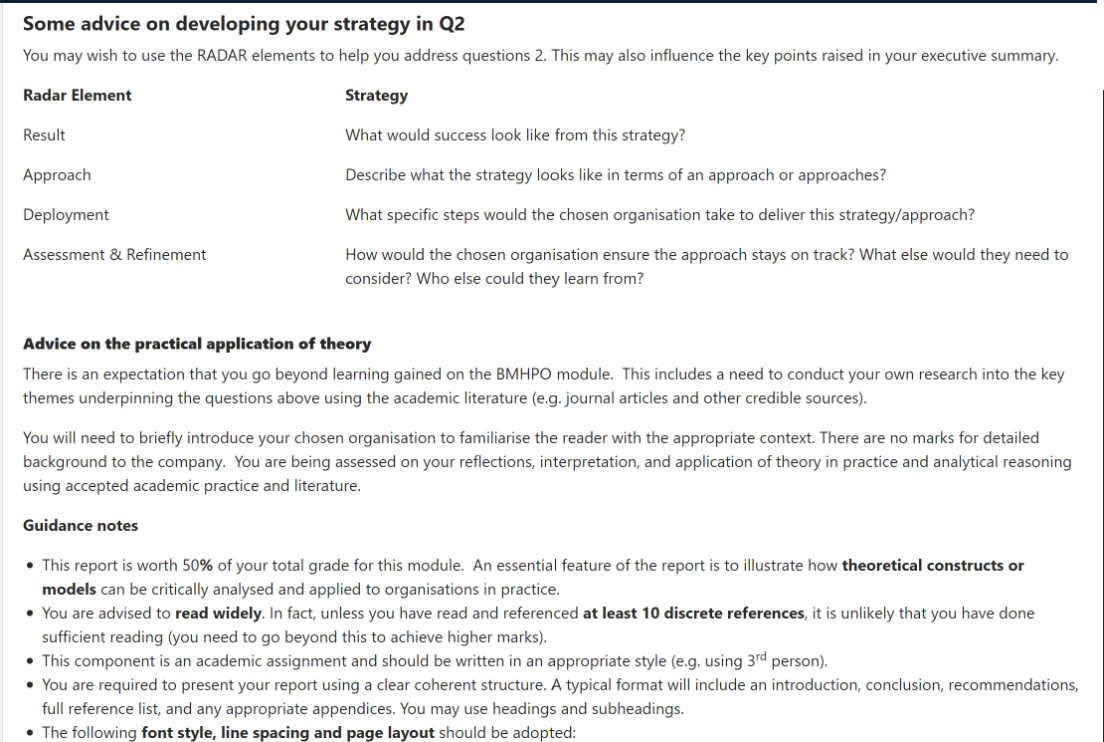
You may wish to use the RADAR elements to help you address questions 2. This may also influence the key points raised in your executive summary.
Radar Element
Strategy
What would success look like from this strategy?
Describe what the strategy looks like in terms of an approach or approaches?
What specific steps would the chosen organisation take to deliver this strategy/approach?
How would the chosen organisation ensure the approach stays on track? What else would they need to
consider? Who else could they learn from?
Result
Approach
Deployment
Assessment & Refinement
Advice on the practical application of theory
There is an expectation that you go beyond learning gained on the BMHPO module. This includes a need to conduct your own research into the key
themes underpinning the questions above using the academic literature (e.g. journal articles and other credible sources).
You will need to briefly introduce your chosen organisation to familiarise the reader with the appropriate context. There are no marks for detailed
background the company. You are being assessed on your reflections, interpretation, and application of in practice and analytical reasoning
using accepted academic practice and literature.
Guidance notes
• This report is worth 50% of your total grade for this module. An essential feature of the report is to illustrate how theoretical constructs or
models can be critically analysed and applied to organisations in practice.
• You are advised to read widely. In fact, unless you have read and referenced at least 10 discrete references, it is unlikely that you have done
sufficient reading (you need to go beyond this to achieve higher marks).
• This component is an academic assignment and should be written in an appropriate style (e.g. using 3rd person).
• You are required to present your report using a clear coherent structure. A typical format will include an introduction, conclusion, recommendations,
full reference list, and any appropriate appendices. You may use headings and subheadings.
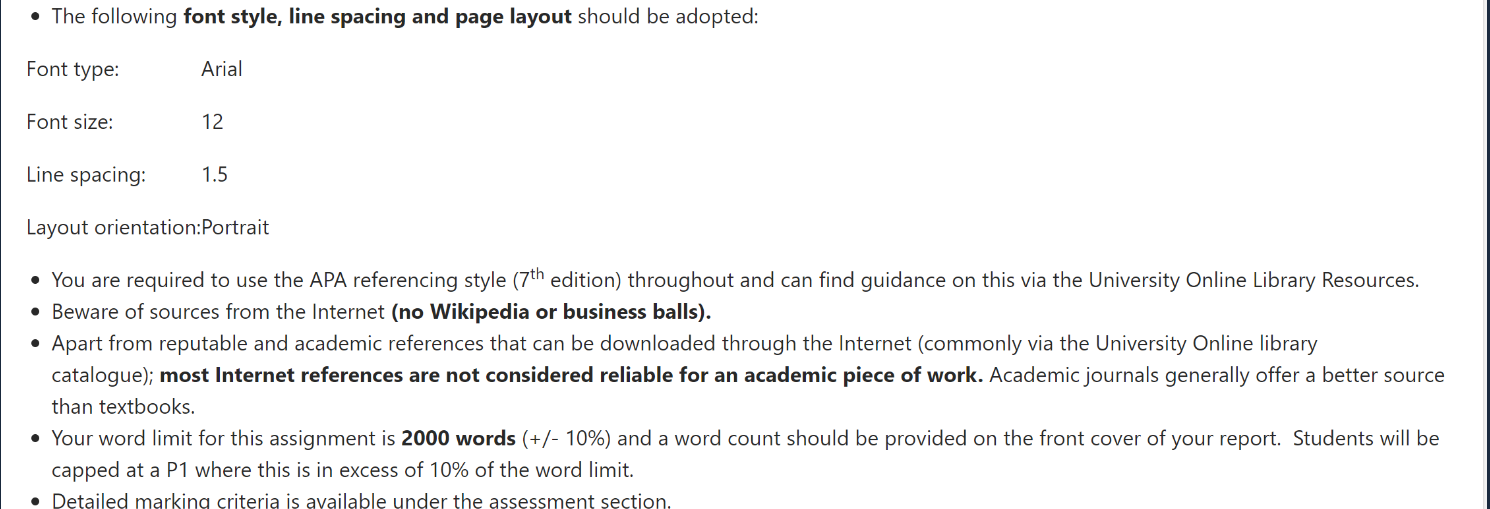
• The following font style, line spacing and page layout should be adopted:/n• The following font style, line spacing and page layout should be adopted:
Font type:
Font size:
Arial
12
Line spacing:
Layout orientation:Portrait
• You are required to use the APA referencing style (7th edition) throughout and can find guidance on this via the University Online Library Resources.
• Beware of sources from the Internet (no Wikipedia or business balls).
• Apart from reputable and academic references that can be downloaded through the Internet (commonly via the University Online library
catalogue); most Internet references are not considered reliable for an academic piece of work. Academic journals generally offer a better source
than textbooks.
• Your word limit for this assignment is 2000 words (+/- 10%) and a word count should be provided on the front cover of your report. Students will be
capped at a P1 where this is in excess of 10% of the word limit.
• Detailed marking criteria is available under the assessment section.
1.5