HW 6 LeChatelier's Principle
1. Le Chatelier: Concentration
2 Le Chatelier: Volume
Preparation
Question
Question
Question
3 Le Chatelier Temperature
Le Chatelier Endo or Exothermic
Le Chatelier: Summary True/False
1 pts 2req
1 pts 2req
O
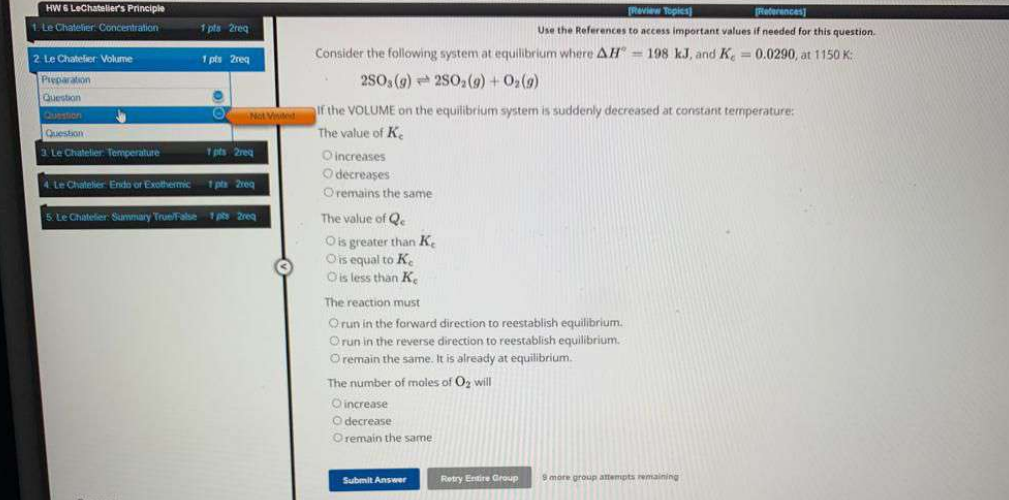
Not Vied If the VOLUME on the equilibrium system is suddenly decreased at constant temperature:
The value of Ke
1 pts 2req
1ptx 2req
[Review Topics
References]
Use the References to access important values if needed for this question.
Consider the following system at equilibrium where AH = 198 kJ, and K = 0.0290, at 1150 K:
2SO3(g) 2SO₂(g) + O2(g)
1 pts 2req
O increases
O decreases
Oremains the same
The value of Qe
O is greater than Ke
O is equal to Ke
O is less than Ke
The reaction must
Orun in the forward direction to reestablish equilibrium.
Orun in the reverse direction to reestablish equilibrium.
O remain the same. It is already at equilibrium.
The number of moles of O₂ will
O increase
O decrease
Oremain the same
Submit Answer
Retry Entire Group
9 more group attempts remaining/nC
prod01-chow-owl.cengagenow.com/ilm/takeAssignment/takeCovalentActivity.do?locator assignment take
HW & LeChatelier's Principle
1. Le Chatelier: Concentration
2 Le Chatelier Volume
Preparation
Question
Question
Question
Le Chatelier Temperature
1 pts 2req
1 pts 2req
1 pts 2req
4 Le Chatelier: Endo or Exothermic 1 pts req
5 Le Chatelier, Summary True/False 1 pts 2req
(3)
[References]
[Review Topics
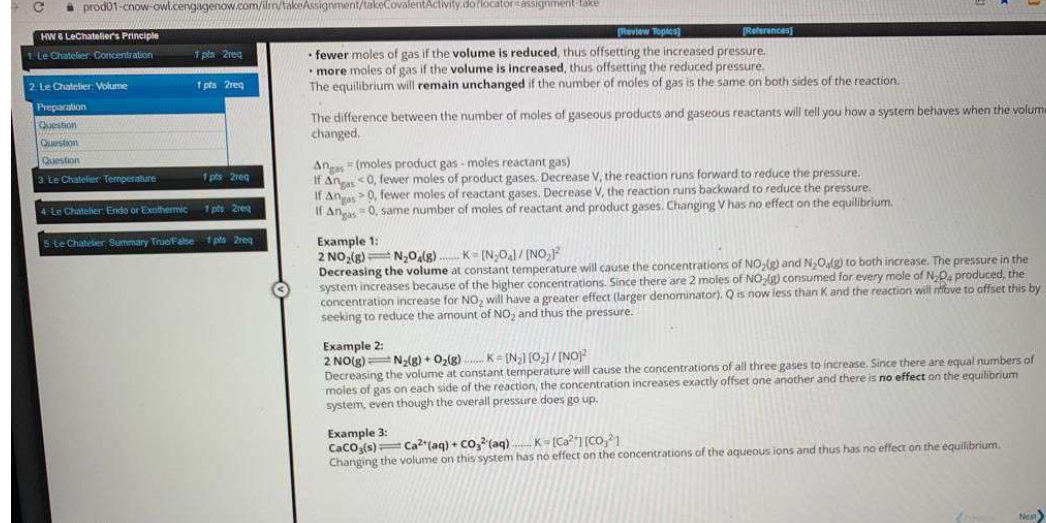
• fewer moles of gas if the volume is reduced, thus offsetting the increased pressure.
more moles of gas if the volume is increased, thus offsetting the reduced pressure.
The equilibrium will remain unchanged if the number of moles of gas is the same on both sides of the reaction.
The difference between the number of moles of gaseous products and gaseous reactants will tell you how a system behaves when the volume
changed.
Angas (moles product gas- moles reactant gas)
If Angas<0, fewer moles of product gases. Decrease V, the reaction runs forward to reduce the pressure.
If Angas >0, fewer moles of reactant gases. Decrease V, the reaction runs backward to reduce the pressure.
If Angas=0, same number of moles of reactant and product gases. Changing V has no effect on the equilibrium.
Example 1:
2 NO₂(g)
N₂O4(8).
K=[N₂O₂]/[NO₂1²
Decreasing the volume at constant temperature will cause the concentrations of NO₂(g) and N₂O(g) to both increase. The pressure in the
system increases because of the higher concentrations. Since there are 2 moles of NO₂(g) consumed for every mole of N₂O4 produced, the
concentration increase for NO₂ will have a greater effect (larger denominator). Q is now less than K and the reaction will move to offset this by
seeking to reduce the amount of NO₂ and thus the pressure.
Example 2:
2 NO(g) N₂(g) + O₂(g) K= [N₂1 [0₂]/[NO]²
Decreasing the volume at constant temperature will cause the concentrations of all three gases to increase. Since there are equal numbers of
moles of gas on each side of the reaction, the concentration increases exactly offset one another and there is no effect on the equilibrium
system, even though the overall pressure does go up.
Example 3:
CaCO3(s) Ca²(aq) + CO₂(aq)K=[Ca²"] [CO,21
-
Changing the volume on this system has no effect on the concentrations of the aqueous ions and thus has no effect on the equilibrium.
Nest/nprod01-cnow-owl.cengagenow.com/ilm/take Assignment/takeCovalent Activity.
HW & LeChatelier's Principle
1: Le Chatelier Concentration
2 Le Chatelier Volume
Preparation
Question
Question
Question
3 Le Chatelier Temperature
4 Le Chatelier: Endo or Exothermic
A
Progress
05 groups
Due Jun 22 at 11:55 PM
Finish Assignment
1 pts 2req
5. Le Chatelier: Summary True/False 1 pts 2req
67°F
Partly sunny
1 pts 2req
1 pts 2req
1 pts 2req
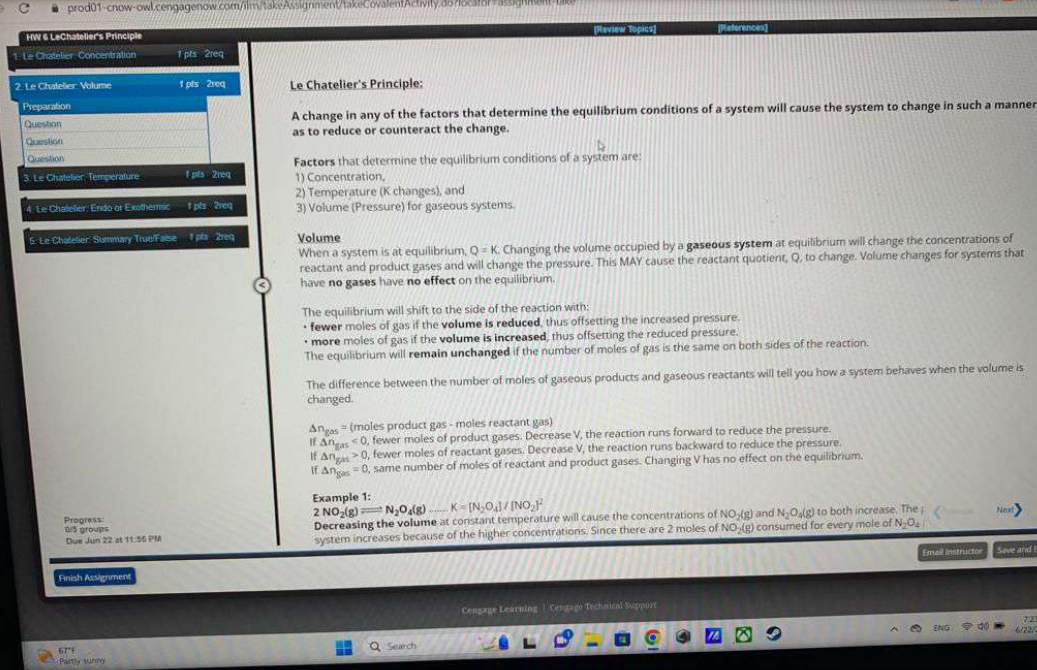
Le Chatelier's Principle:
A change in any of the factors that determine the equilibrium conditions of a system will cause the system to change in such a manner
as to reduce or counteract the change.
Factors that determine the equilibrium conditions of a system are:
1) Concentration,
2) Temperature (K changes), and
3) Volume (Pressure) for gaseous systems.
[Review Topics]
Volume
When a system is at equilibrium, Q=K. Changing the volume occupied by a gaseous system at equilibrium will change the concentrations of
reactant and product gases and will change the pressure. This MAY cause the reactant quotient, Q, to change. Volume changes for systems that
have no gases have no effect on the equilibrium.
The equilibrium will shift to the side of the reaction with:
fewer moles of gas if the volume is reduced, thus offsetting the increased pressure.
more moles of gas if the volume is increased, thus offsetting the reduced pressure.
The equilibrium will remain unchanged if the number of moles of gas is the same on both sides of the reaction.
The difference between the number of moles of gaseous products and gaseous reactants will tell you how a system behaves when the volume is
changed.
References]
Angas (moles product gas- moles reactant gas)
If Angas <0, fewer moles of product gases. Decrease V, the reaction runs forward to reduce the pressure.
If Angs>0, fewer moles of reactant gases. Decrease V, the reaction runs backward to reduce the pressure.
If Angs=0, same number of moles of reactant and product gases. Changing V has no effect on the equilibrium.
H
Example 1:
2 NO₂(g) = N₂O₂(g) K-[N₂O1/[NO₂)²
Decreasing the volume at constant temperature will cause the concentrations of NO₂(g) and N₂O(g) to both increase. The C
system increases because of the higher concentrations. Since there are 2 moles of NO (g) consumed for every mole of N₂O₂
Q Search
Cengage Learning Cengage Technical Support
5
O
9
Email Instructor
Next>
Save and E
ENG 9.00->>
72