I need to respond to these 2 posts (150 words each with, references.)
Post 1
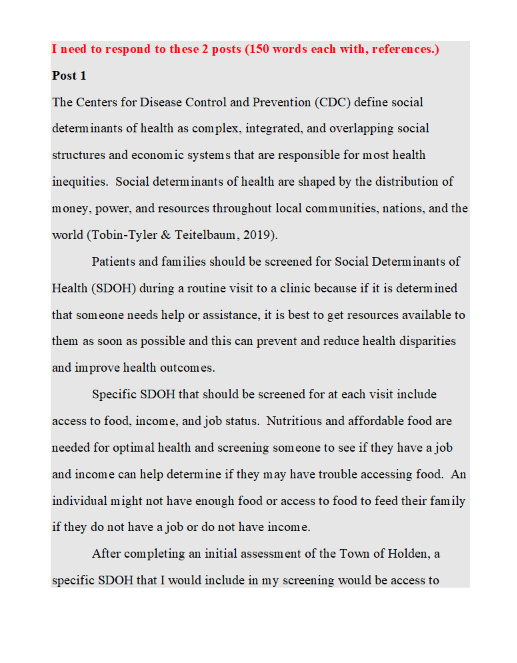
The Centers for Disease Control and Prevention (CDC) define social
determinants of health as complex, integrated, and overlapping social
structures and economic systems that are responsible for most health
inequities. Social determinants of health are shaped by the distribution of
money, power, and resources throughout local communities, nations, and the
world (Tobin-Tyler & Teitelbaum, 2019).
Patients and families should be screened for Social Determinants of
Health (SDOH) during a routine visit to a clinic because if it is determined
that someone needs help or assistance, it is best to get resources available to
them as soon as possible and this can prevent and reduce health disparities
and improve health outcomes.
Specific SDOH that should be screened for at each visit include
access to food, income, and job status. Nutritious and affordable food are
needed for optimal health and screening someone to see if they have a job
and income can help determine if they may have trouble accessing food. An
individual might not have enough food or access to food to feed their family
if they do not have a job or do not have income.
After completing an initial assessment of the Town of Holden, a
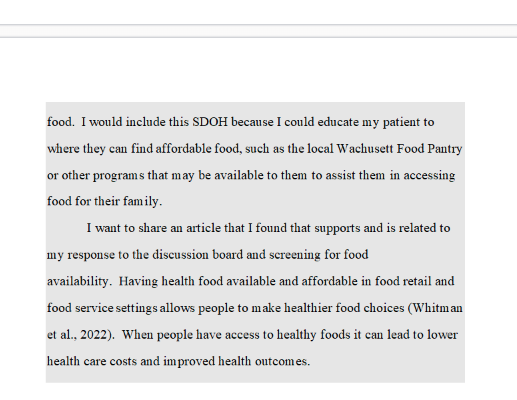
specific SDOH that I would include in my screening would be access to/nfood. I would include this SDOH because I could educate my patient to
where they can find affordable food, such as the local Wachusett Food Pantry
or other programs that may be available to them to assist them in accessing
food for their family.
I want to share an article that I found that supports and is related to
my response to the discussion board and screening for food
availability. Having health food available and affordable in food retail and
food service settings allows people to make healthier food choices (Whitman
et al., 2022). When people have access to healthy foods it can lead to lower
health care costs and improved health outcomes./nPost 2
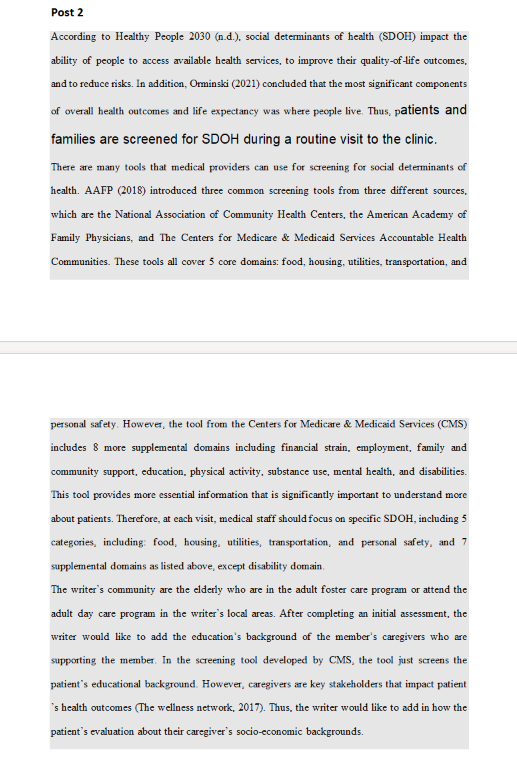
According to Healthy People 2030 (n.d.), social determinants of health (SDOH) impact the
ability of people to access available health services, to improve their quality-of-life outcomes.
and to reduce risks. In addition, Orminski (2021) concluded that the most significant components
of overall health outcomes and life expectancy was where people live. Thus, patients and
families are screened for SDOH during a routine visit to the clinic.
There are many tools that medical providers can use for screening for social determinants of
health. AAFP (2018) introduced three common screening tools from three different sources,
which are the National Association of Community Health Centers, the American Academy of
Family Physicians, and The Centers for Medicare & Medicaid Services Accountable Health
Communities. These tools all cover 5 core domains: food, housing, utilities, transportation, and
personal safety. However, the tool from the Centers for Medicare & Medicaid Services (CMS)
includes 8 more supplemental domains including financial strain, employment, family and
community support, education, physical activity, substance use, mental health, and disabilities.
This tool provides more essential information that is significantly important to understand more
about patients. Therefore, at each visit, medical staff should focus on specific SDOH, including 5
categories, including: food, housing, utilities, transportation, and personal safety, and 7
supplemental domains as listed above, except disability domain.
The writer's community are the elderly who are in the adult foster care program or attend the
adult day care program in the writer's local areas. After completing an initial assessment, the
writer would like to add the education's background of the member's caregivers who are
supporting the member. In the screening tool developed by CMS, the tool just screens the
patient's educational background. However, caregivers are key stakeholders that impact patient
's health outcomes (The wellness network, 2017). Thus, the writer would like to add in how the
patient's evaluation about their caregiver's socio-economic backgrounds.