In the following exercises, use the Hamilton method of apportionment to answer the questions.
1) When the number of seats changed from 147 to 148, the standard quotas changed from A 44.24, B
17.35, C 37.12, and D 48.29 to A 45.54, B 17.47, C 37.37, and D 48.62.
a. How did the increase in seats impact the apportionment?
b. Is this apportionment an example of a paradox? Justify your answer.
You need to do all Questions in Handwritten Solution/n2) When the number of seats changed from 126 to 127, the standard quotas changed from A 9.57, B
29.49, C 33.89, D 28.43, and E 24.61 to A 9.65, B 29.72, C 34.16, D 28.66, and E 24.81.
a. How did the increase in seats impact the apportionment?
b. Is this apportionment an example of a paradox? Justify your answer.
3) When the number of seats changed from 25 to 26, the standard quotas changed from A 2.21, B
5.25, C 11.27, and D 6.28 to A 2.30, B 5.46, C 11.72, and D 6.52.
a. How did the increase in seats impact the apportionment?
b. Is this apportionment an example of a paradox? Justify your answer.
4) When the number of seats changed from 15 to 16, the standard quotas changed from A 2.43, 8
5.42, and C 8.15 to A 2.46, B 5.47, and C 8.07.
a. How did the increase in seats impact the apportionment?
b. Is this apportionment an example of a paradox? Justify your answer.
5) The house size is 18. When the population of State A increases by 11.76 percent, State B increases
by 16.22 percent, and State C increases by 12.18 percent, the standard quotas change from A 2.46,
B 6.00, and C 9.53 to A 2.41, B 6.25, and C 9.34.
a. How did the change in populations impact the apportionment?
b. Is this apportionment an example of a paradox? Justify your answer.
6) The house size is 100. When the population of State A increases by 20 percent, State B increases by
10 percent, State C increases by 30 percent, and the populations of States D, E, and F remain the
same. The standard quotas change from A 12.50, B 25.00, C 9.38, D 18.75, E 12.50 and F 21.88 to A
13.91, 8 25.51, C 11.30, D 17.39, E 11.59, and F 20.29.
a. How did the change in populations impact the apportionment?
b. Is this apportionment an example of a paradox? Justify your answer.
7) The house size is 17. When the population of State A increases by 12.73 percent, State B increases
by 15.63 percent, and State C Increases by 12.90 percent, the standard quotas change from A 2.53,
B 5.90, and C 8.57 to A 2.51, B 5.99, and C 8.50.
a. How did the change in populations impact the apportionment?
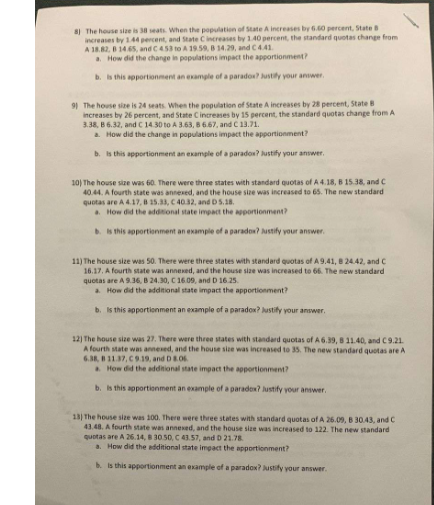
b. Is this apportionment an example of a paradox? Justify your answer./n8) The house size is 38 seats. When the population of State A increases by 6.60 percent, State B
increases by 1.44 percent, and State Cincreases by 1.40 percent, the standard quotas change from
A 18.82, B 14.45, and C 453 to A 19.59, 8 14.29, and C 4.41.
a. How did the change in populations impact the apportionment?
b. Is this apportionment an example of a paradox? Justify your answer.
91 The house size is 24 seats. When the population of State A increases by 28 percent, State B
increases by 26 percent, and State C increases by 15 percent, the standard quotas change from A
3.38, B 6.32, and C 14.30 to A 3.63, 8 6.67, and C 13.71.
a. How did the change in populations impact the apportionment?
b. Is this apportionment an example of a paradox? Justify your answer.
10) The house size was 60. There were three states with standard quotas of A 4.18, B 15.38, and C
40.44. A fourth state was annexed, and the house size was increased to 65. The new standard
quotas are A 4.17, 8 15.33, C 40.32, and D 5.18.
a. How did the additional state impact the apportionment?
b. Is this apportionment an example of a paradox? Jus y your anse
11) The house size was 50. There were three states with standard quotas of A 9.41, 8 24.42, and C
16.17. A fourth state was annexed, and the house size was increased to 66. The new standard
quotas are A 9.36, B 24.30, C 16.09, and D 16.25
a. How did the additional state impact the apportionment?
b. Is this apportionment an example of a paradox? Justify your answer.
12) The house size was 27. There were three states with standard quotas of A 6.39, 8 11.40, and C 9.21.
A fourth state was annexed, and the house size was increased to 35. The new standard quotas are A
6.38, B 11.37, C 9.19, and D 8.06.
a. How did the additional state impact the apportionment?
b. Is this apportionment an example of a paradox? Justify your answer.
13) The house size was 100. There were three states with standard quotas of A 26.09, B 30.43, and C
43.48. A fourth state was annexed, and the house size was increased to 122. The new standard
tas are A 26.14, 830.50, C 43.57, and D 21.78
a. How did the additional state impact the apportionment?
b. Is this apportionment an example of a paradox? Justify your answer.