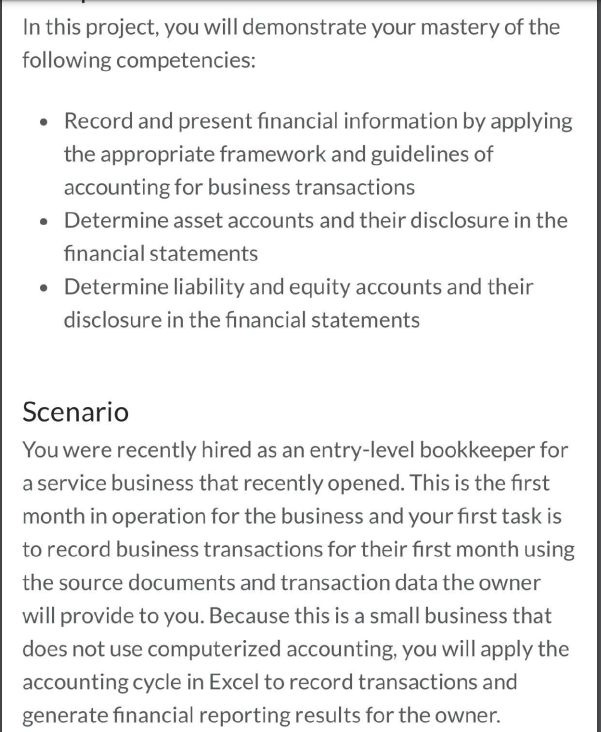
In this project, you will demonstrate your mastery of the
following competencies:
• Record and present financial information by applying
the appropriate framework and guidelines of
accounting for business transactions
• Determine asset accounts and their disclosure in the
financial statements
• Determine liability and equity accounts and their
disclosure in the financial statements
Scenario
You were recently hired as an entry-level bookkeeper for
a service business that recently opened. This is the first
month in operation for the business and your first task is
to record business transactions for their first month using
the source documents and transaction data the owner
will provide to you. Because this is a small business that
does not use computerized accounting, you will apply the
accounting cycle in Excel to record transactions and
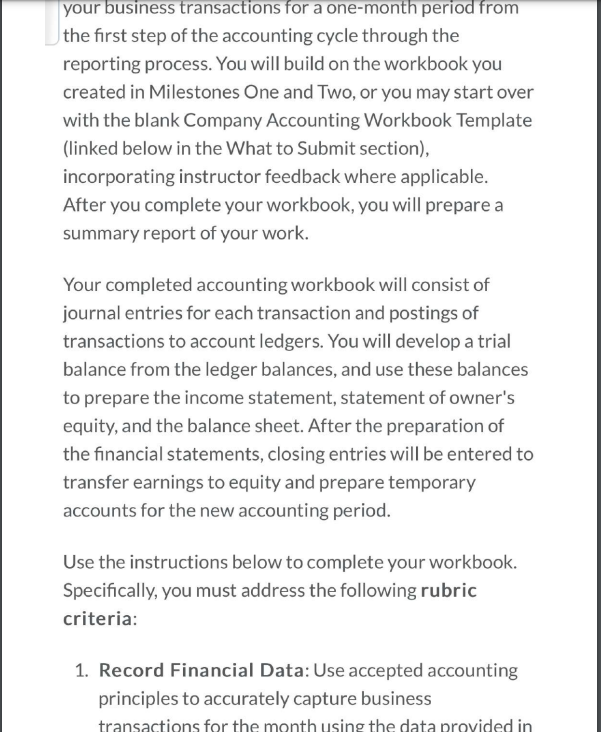
generate financial reporting results for the owner./nyour business transactions for a one-month period from
the first step of the accounting cycle through the
reporting process. You will build on the workbook you
created in Milestones One and Two, or you may start over
with the blank Company Accounting Workbook Template
(linked below in the What to Submit section),
incorporating instructor feedback where applicable.
After you complete your workbook, you will prepare a
summary report of your work.
Your completed accounting workbook will consist of
journal entries for each transaction and postings of
transactions to account ledgers. You will develop a trial
balance from the ledger balances, and use these balances
to prepare the income statement, statement of owner's
equity, and the balance sheet. After the preparation of
the financial statements, closing entries will be entered to
transfer earnings to equity and prepare temporary
accounts for the new accounting period.
Use the instructions below to complete your workbook.
Specifically, you must address the following rubric
criteria:
1. Record Financial Data: Use accepted accounting
principles to accurately capture business
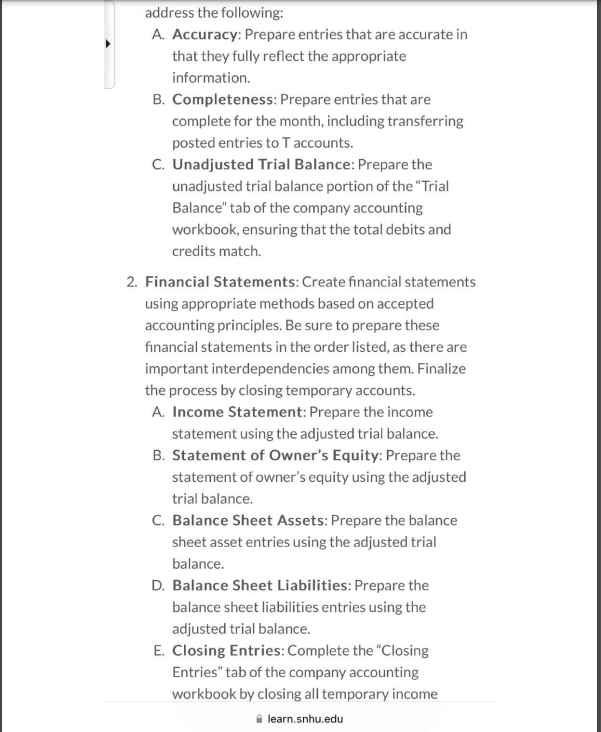
transactions for the month using the data provided in/naddress the following:
A. Accuracy: Prepare entries that are accurate in
that they fully reflect the appropriate
information.
B. Completeness: Prepare entries that are
complete for the month, including transferring
posted entries to T accounts.
C. Unadjusted Trial Balance: Prepare the
unadjusted trial balance portion of the "Trial
Balance" tab of the company accounting
workbook, ensuring that the total debits and
credits match.
2. Financial Statements: Create financial statements
using appropriate methods based on accepted
accounting principles. Be sure to prepare these
financial statements in the order listed, as there are
important interdependencies among them. Finalize
the process by closing temporary accounts.
A. Income Statement: Prepare the income
statement using the adjusted trial balance.
B. Statement of Owner's Equity: Prepare the
statement of owner's equity using the adjusted
trial balance.
C. Balance Sheet Assets: Prepare the balance
sheet asset entries using the adjusted trial
balance.
D. Balance Sheet Liabilities: Prepare the
balance sheet liabilities entries using the
adjusted trial balance.
E. Closing Entries: Complete the "Closing
Entries" tab of the company accounting
workbook by closing all temporary income
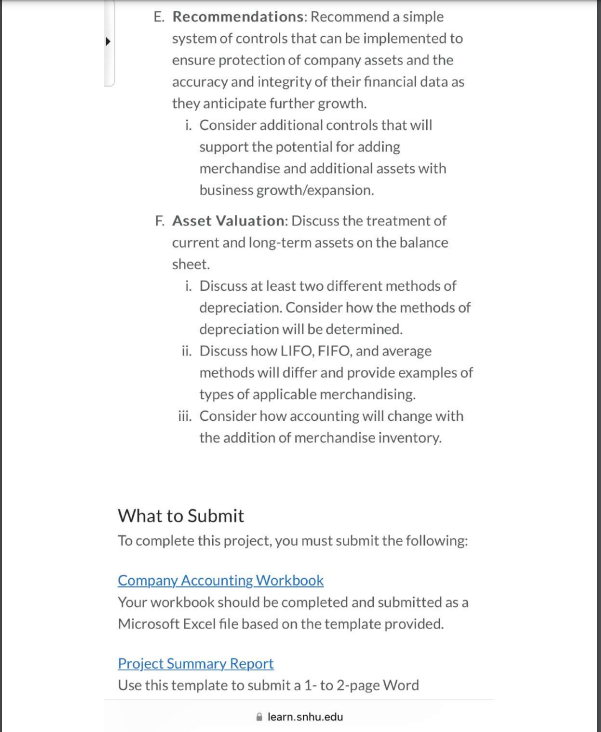
learn.snhu.edu/nE. Recommendations: Recommend a simple
system of controls that can be implemented to
ensure protection of company assets and the
accuracy and integrity of their financial data as
they anticipate further growth.
i. Consider additional controls that will
support the potential for adding
merchandise and additional assets with
business growth/expansion.
F. Asset Valuation: Discuss the treatment of
current and long-term assets on the balance
sheet.
i. Discuss at least two different methods of
depreciation. Consider how the methods of
depreciation will be determined.
ii. Discuss how LIFO, FIFO, and average
methods will differ and provide examples of
types of applicable merchandising.
iii. Consider how accounting will change with
the addition of merchandise inventory.
What to Submit
To complete this project, you must submit the following:
Company Accounting Workbook
Your workbook should be completed and submitted as a
Microsoft Excel file based on the template provided.
Project Summary Report
Use this template to submit a 1- to 2-page Word
learn.snhu.edu