INSTRCUTIONS
Need to discussion and project part in 150 words each, following all the guidelines
Week 1 Discussion
Discussion Topic Task: Reply to this topic
Imagery and the Language of Poetry
By the due date assigned, post your response of one or two paragraphs (at least 150-200 words) to
the Discussion Area. To support your comments, your discussion answers should include specific
information and quotations from the readings. By the end of Week 1, comment on at least two of
your classmates' submissions. Your replies to classmates should be at least a paragraph in length and
made with an eye to expand, clarify, defend, and/or refine their thoughts. Consider asking questions
to further meaningful conversation. Be clear and concise, referring to specific ideas and words from
your classmates' postings. Participation must be completed by the end of the first week to earn
credit.
Prompt:
Choose a poem from the assigned readings listed below, and identify some of the key imagery or
other kinds of poetic language used in the poem, which you believe are vital to understanding it.
Here are some possible approaches:
Provide a detailed discussion of how the images function in the poem.
Do the images work together to form a coherent pattern?
What ideas or feelings are conveyed by the images or figurative language?
How do the images contribute to the overall meaning of the poem?
Our course eBook (Portable Literature) should be your only source. Do not use outside sources.
Title your discussion response with the poem's title. This will help other students see which poems
have been discussed. Once a poem has been discussed twice, please do not choose it for analysis.
Read the following poems and choose one to discuss:
Alacor, "Mexican' Is Not a Noun"
Alvarez, "Dusting"
Bradstreet, "To My Dear and Loving Husband"
Browning, "How Do I Love Thee"
Burns, "Oh, My Love is Like a Red, Red Rose"
Cummings, "Next to of Course God America I"
Cummings, "Since Feeling is First"
Dunbar, "We Wear the Mask"/nCummings, "Since Feeling is First"
Dunbar, "We Wear the Mask"
Epada, "My Father as a Guitar"
Hayden, "Those Winter Sundays"
Heaney, "Digging"
Heaney, "Mid-Term Break"
Herrick, "To the Virgins, to Make Much of Time"
Hopkins, "Spring and Fall"
Jarrell, "The Death of the Ball Turret Gunner"
Komunyakaa, "Facing It"
MacLeish, "Ars Poetica"
Marlowe, "The Passionate Shepherd to His Love"
McKay, "The White City"
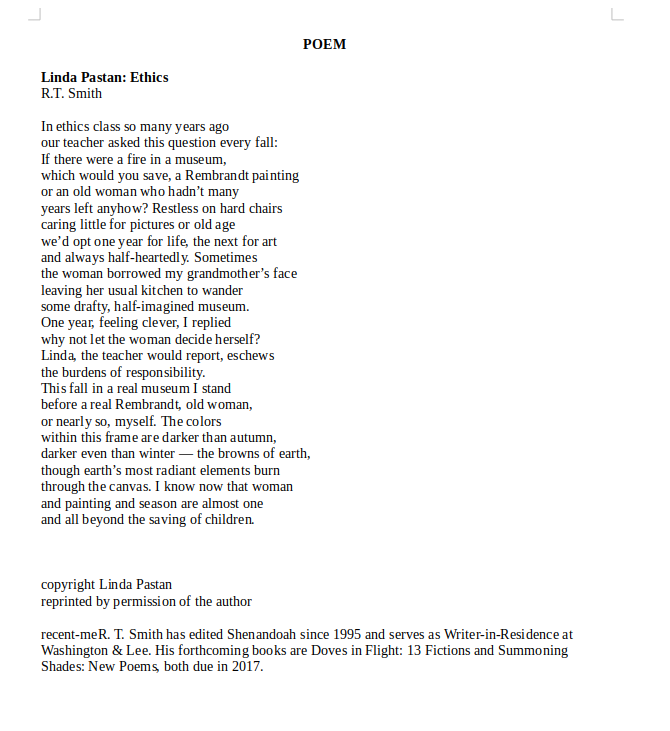
Pastan, "Ethics"
Plath, "Daddy"
Pound, "The River-Merchant's Wife: A Letter"
Randall, "Ballad of Birmingham"
Rich, "Living in Sin"
Robinson, "Miniver Cheevy"
Roethke, "My Papa's Waltz"
Shakespeare, "Let Me Not to the Marriage of True Minds"
Shakespeare, "My Mistress' Eyes Are Nothing Like the Sun"
Shakespeare, "Shall I Compare Thee to a Summer's Day?"
Smith, "Not Waving but Drowning"
Stevens, "Anecdote of the Jar"
Stevens, "The Snow Man"
Yeats, "The Second Coming"
Yeats, "When You Are Old"
Tips
L/nRemember to provide evidence for your claims in the form of quoted passages from the poem.
Quotations, paraphrases, and summaries should be cited according to APA rules of style, including
in-text and reference citations. Quoted material should not exceed 25% of the document.
Visit the South University Online Citation Resources: APA Style page for information regarding
properly citing resources.
Post directly to the discussion; do not attach a document. Make sure you check spelling and
grammar, and use APA style for citations.
Example Response
Students often ask to see a model of what is expected, so here is an example post:
"The Oven Bird" is a sonnet by Robert Frost, and the poem focuses on a bird that sings a sad song
about death and loss. Some of the key images include variations on singing, the seasons, and
foliage, such as leaves and flowers. The following lines illustrate the use of these images: "He says
that leaves are old and that for flowers/Mid-summer is to spring as one to ten/He says the early
petal-fall is past/When pear and cherry bloom went down in showers" (Frost, 1916, Lines 4-7). The
images in the poem work together to tell a story about the oven bird, which has a loud, discordant
song that "makes the solid tree trunks sound again" (Frost, 1916, Line 3). The bird sings about
having lost its first set of young to predators, and now the bird must learn to go on living with great
loss. The sad yet brave feeling of the poem is summed up in the final couplet: "The question that he
frames in all but words/Is what to make of a diminished thing" (Frost, 1916, Lines 13-14).
Frost, R. (1916). The oven bird. Cengage: Gale College Collection. https://go.gale.com/ps/i.do?
p=GCCO&u=gale 9827877&id=GALE
BRGOHW412836445&v=2.1&it=r&sPage=13883791&sid=mindtap-embedView&asid=94ec534a/nWeek 1 Project
Assignment
Task: Submit to complete this assignment
By the end of Week 1, submit your one-paragraph response of at least 150 words as a
Microsoft Word attachment to the Project Submission Area.
Prompt:
Read the poems from the lists in Weeks 1 and 2. You can find them in the Syllabus, in the
Discussions, and under the weekly Content.
Read ahead in Week 2, looking specifically at the directions for the upcoming essay assignment that
will be due next week.
Choose a poem from the assigned readings that you are interested in exploring in more depth for the
writing project in Week 2. The poem can be from Week 1 or Week 2.
Title your paragraph with the title of the poem.
In a well-developed paragraph, explain:
Why are you interested in exploring this poem?
What literary elements (such as imagery, symbolism, metaphor, simile, etc.) do you see the author
using in the poem?
What approach might you take in analyzing this poem? Example approaches include a discussion of
the poem's use of imagery, symbolism, theme, or characterization.
What questions do you have for the instructor about the upcoming essay assignment?
The poem should be your only source for this post. Do not use outside sources.