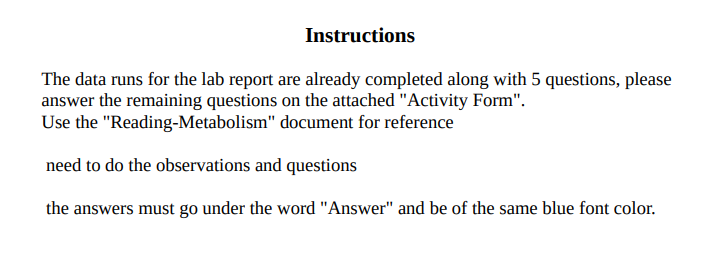
Instructions
The data runs for the lab report are already completed along with 5 questions, please
answer the remaining questions on the attached "Activity Form".
Use the "Reading-Metabolism" document for reference
need to do the observations and questions
the answers must go under the word "Answer" and be of the same blue font color./n Data Sheet: Activity - Photosynthesis and Respiration
It is a serious Violation of Copyright Law to Post or Share this document ANYWHERE except your Classroom.
Posting or sharing this document outside of your classroom can result in account termination and legal action.
Do not post ANY Table Top Science (TTS) content or questions outside of your classroom.
Name
Course
Date
Biol 103 7377
April 14, 2024
Activity Data Code: LCX
The Activity Data Code (3 letters) can be found under the Activity Form tab on the TTS site.
Screenshot
Paste a screenshot of the completed Procedure I data run below. Make sure you know how
your computer/device saves screenshots. Follow this link to get details on how to take and
save a screenshot.
Paste screenshot here:
Lab Menu
Background
Table Top Science - Lab Activity: Metabolism
Procedure
Activity
Activity Form
Pick a leaf sample and click "Display Data." Options: adjust illumination using the slider.
Sign Out
Leaf
Samples
Sun
Adapted
Shade
Adapted
Danielle ONeal is
02
Probe
Photosynthesis
Display Data
CO₂
Probe
Illumination: 100 %
Time: 40.0 s
Data Run Complete!
illumination slider
Carbon Dioxide
Concentration Change
Oxygen
Concentration Change
30
30
Change (ppm)
505
Change (ppm)
15
0
15
-30
- 30
04/14/2024 12:07 AM LCX
19.78 ppm
02 Change:
CO2 Change: -19.78 ppm
Table Top Science Copyright 2016-2024 All Rights Reserved
Table Top Science - All Rights Reserved
Reset
1 Procedure I - Net Photosynthesis Rates - 100% Illumination
Complete the tables below using your data and information found under the Background tab
(see the Summary of Needed Formulas section)
Leaf
Illumination
Sample
Type
Level
Oxygen
Concentration
Elapsed
Time
Oxygen
Change Rate
Change Data
(s)
(ppm/s)
(ppm)
Sun-
Adapted
100%
19.78
40.0
0.4945
Shade-
Adapted
100%
12.00
40.0
0.30
Leaf
Sample
Type
Illumination
Level
Carbon Dioxide
Concentration
Elapsed
Time
Carbon Dioxide
Change Rate
Change Data
(s)
(ppm/s)
(ppm)
Sun-
Adapted
100%
-19.78
40.0
-0.4945
Shade-
Adapted
100%
-12.00
40.0
-0.30
Observations and Questions
[1] What is the function of chlorophyll in photosynthesis?
Answer:
Chlorophyll's main role is to absorb sunlight and transform water and carbon dioxide into
glucose and oxygen.
[2] What are enzymes? What is their function in biological and chemical reactions?
Specifically, what do they do to a chemical reaction's activation energy?
2
Table Top Science - All Rights Reserved Answer:
[3] How might enzyme concentration differences affect rates of photosynthesis and
respiration?
Answer:
[4] Show your oxygen change rate calculation for the Sun-Adapted data run. Be sure to include
the units of measurement for each step.
Calculation:
O2 = change rate / time interval
02 19.78 ppm / 40 s
02 0.4945 ppm/s
[5] Show your carbon dioxide change rate calculation for the Shade-Adapted data run. Be sure
to include the units of measurement for each step.
Calculation:
CO2 = change rate / time interval
CO2 -19.78/40 s
CO2 = -0.4945 ppm/s
[6] (a) What is the chemical reaction for photosynthesis?
Answer (a):
6H2O + 6CO2 → 602 + C6H12O6
(b) Carefully examine your results from Procedure I. Do your results support the relationship
between oxygen and carbon dioxide shown in the chemical reaction? Explain and cite your
results as part of your explanation.
Answer (b):
[7] In procedure I, the oxygen concentration changes differed between sun-adapted leaves and
shade adapted leaves. Can chlorophyll concentrations alone explain the differences seen
between the two leaf types? Explain your answer, citing your results to support this.
Answer:
Table Top Science - All Rights Reserved
3 [8] What is the difference between photosynthesis rate and net photosynthesis rate? Which
rate are you determining in this procedure? Explain.
Answer:
Photosynthesis rate is the overall rate of carbon fixation while net photosynthesis rate is the
carbon fixation rate minus the carbon loss rate in respiration.
[9] Can respiration occur when illumination is 100%? Can respiration occur when illumination is
0%? Explain why (or why not) you would expect this?
Answer:
Procedure II - Respiration Rates -0% Illumination Data Run
Complete the tables below using your data and information found under the Background tab
(see the Summary of Needed Formulas section)
Leaf
Illumination
Sample
Level
Oxygen
Concentration
Elapsed
Time
Oxygen
Change Rate
Type
Change Data
(s)
(ppm/s)
(ppm)
Sun-
Adapted
0%
-12.97
40.0
-0.3245
Shade-
Adapted
0%
-7.78
40.0
-0.1945
Leaf
Sample
Type
Illumination
Level
Carbon Dioxide
Concentration
Elapsed
Time
Carbon Dioxide
Change Data
(s)
Change Rate
(ppm/s)
(ppm)
Sun-
Adapted
0%
12.97
40.0
0.3245
Shade-
Adapted
0%
7.78
40.0
0.1945
4
Table Top Science - All Rights Reserved Observations and Questions
[10] What would be the photosynthesis rate if measured at 0% illumination? Explain your
answer. Cite your results from Procedure II to assist with your explanation.
Answer:
[11] Using your results for the change in carbon dioxide concentration in Procedure Il as a
reference, compare the rates of cellular respiration for sun-adapted versus shade-adapted
leaves. Explain the biological principles/bases underlying this comparison.
Answer:
Procedure III - Low-Light Net Photosynthesis Rates -15% Illumination
Complete the table below using your data and information found under the Background tab
(see the Summary of Needed Formulas section)
Leaf
Illumination
Sample
Level
Oxygen
Concentration
Elapsed
Time
Oxygen
Change Rate
Change Data
Type
(s)
(ppm/s)
(ppm)
Sun-
Adapted
15%
4.42
40.0
0.1105
Shade-
Adapted
15%
7.59
40.0
-0.1105
Observations and Questions
[12] Based on the data you collected in Procedures I (100% illumination) and III (15%
illumination), which system of leaves produces the most oxygen: Sun-adapted or shade-
adapted? Is one system (sun- or shade-adapted) more productive than the other in all light
levels? Explain how your results support your answer.
Table Top Science - All Rights Reserved
5