




Learning Goal: To be able to identify zero-force members and understand

Question
Learning Goal:

To be able to identify zero-force members and understand their importance in truss analysis.

Zero-force members occur frequently in trusses and are typically used either to stabilize a truss during construction or to carry transient loads. Truss analysis can be greatly simplified by identifying and,

subsequently, eliminating zero-force members.

Zero-force members

Zero-force members are truss members that carry no load under a given load configuration. Because they carry no load and their weight is negligible, compared with the loads carried by the truss, zero-force

members experience no force. These members can be identified by drawing a free-body diagram of each joint and applying the conditions

ΣΕ = 0

Σ F = 0

where x and y refer to the coordinate system applied at each joint.

Application of the equilibrium conditions leads to a simple method for identifying the zero-force members in planar trusses:

. If the only members of an unloaded joint are two noncollinear members, both members are zero-force members.

• If an unloaded joint has two collinear members and one noncollinear member only, the noncollinear member is a zero-force member.

Part A - Identifying zero-force members

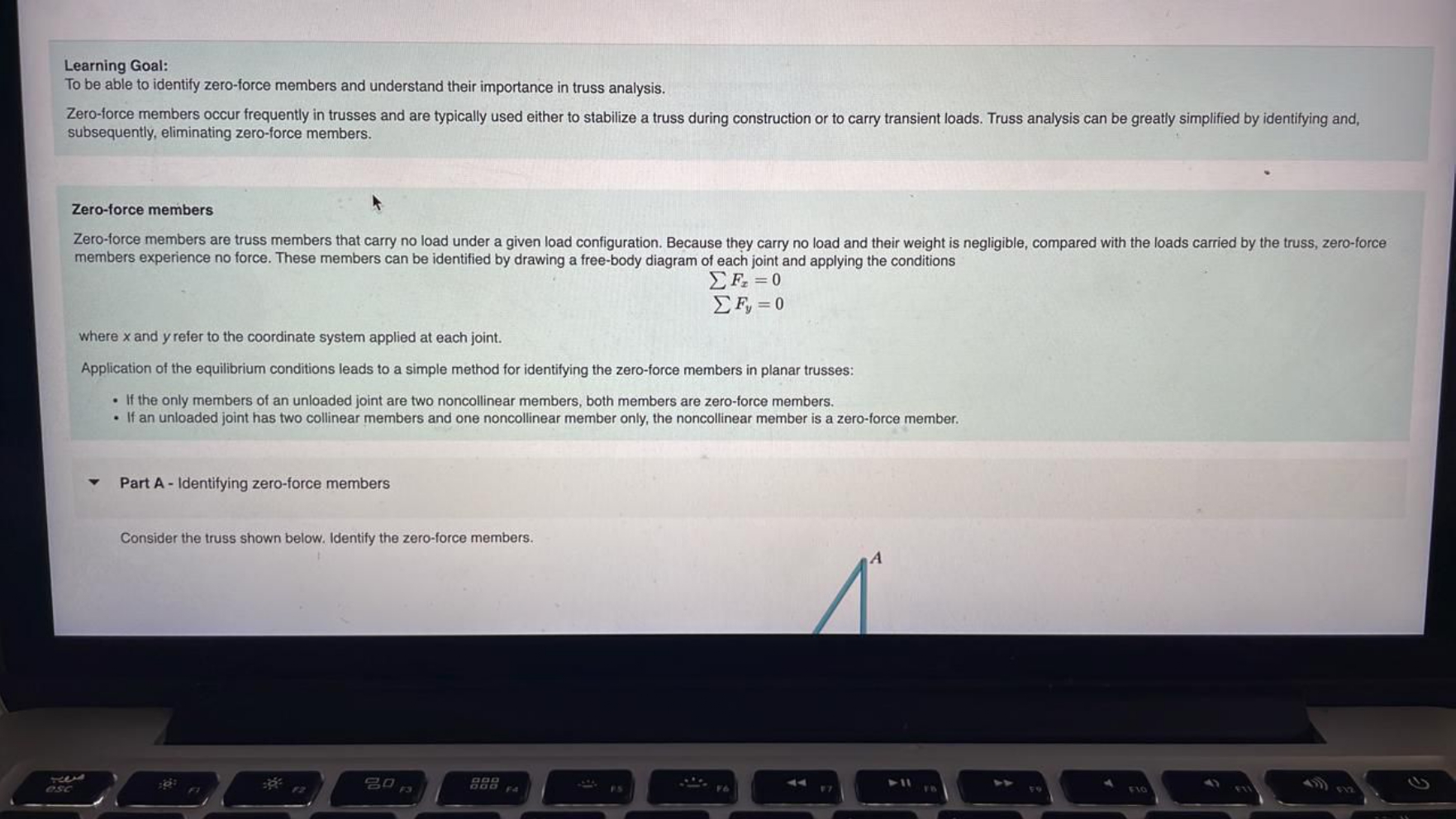
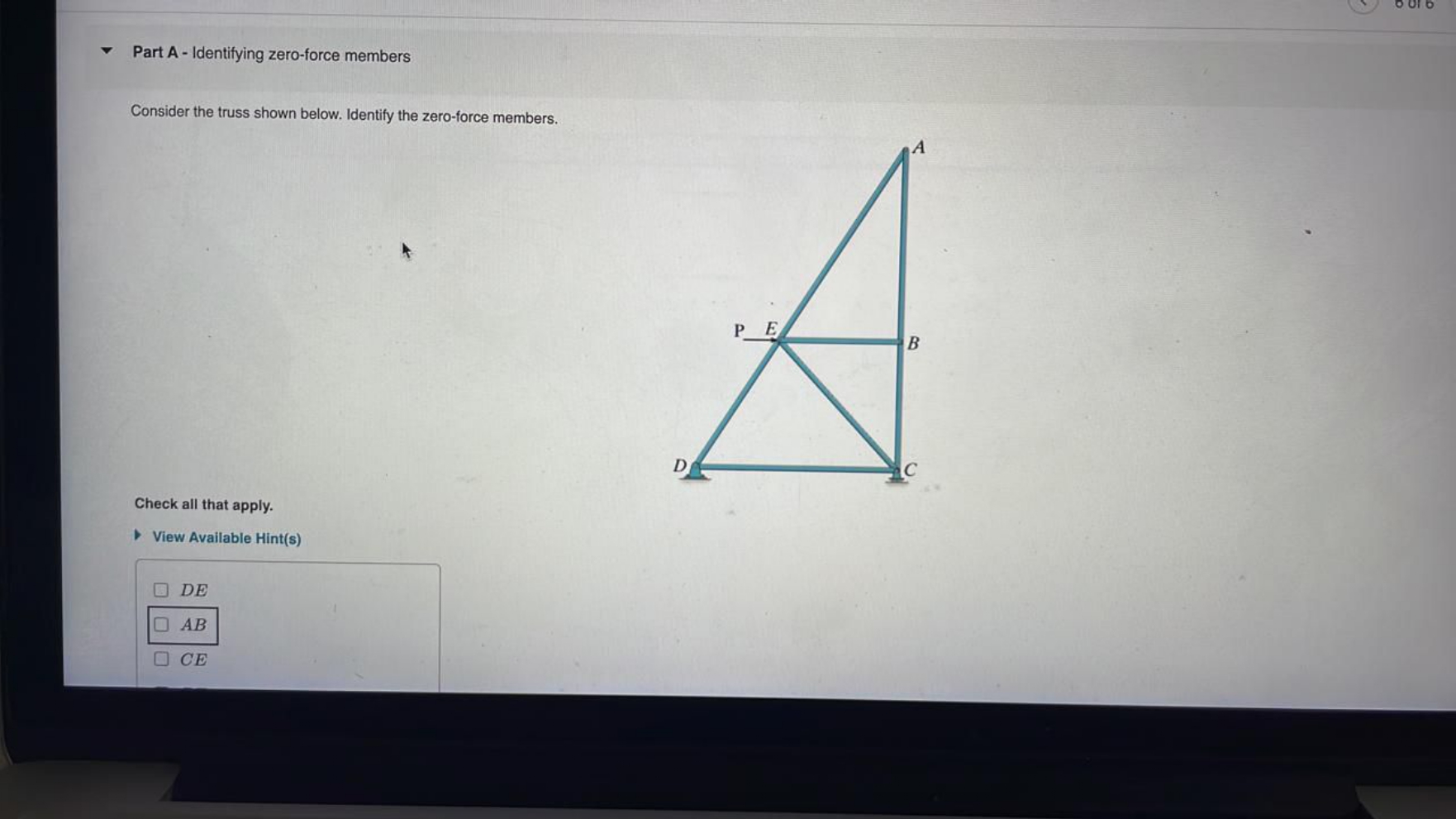
Consider the truss shown below. Identify the zero-force members.

80

888

A

A/n▼ Part A - Identifying zero-force members

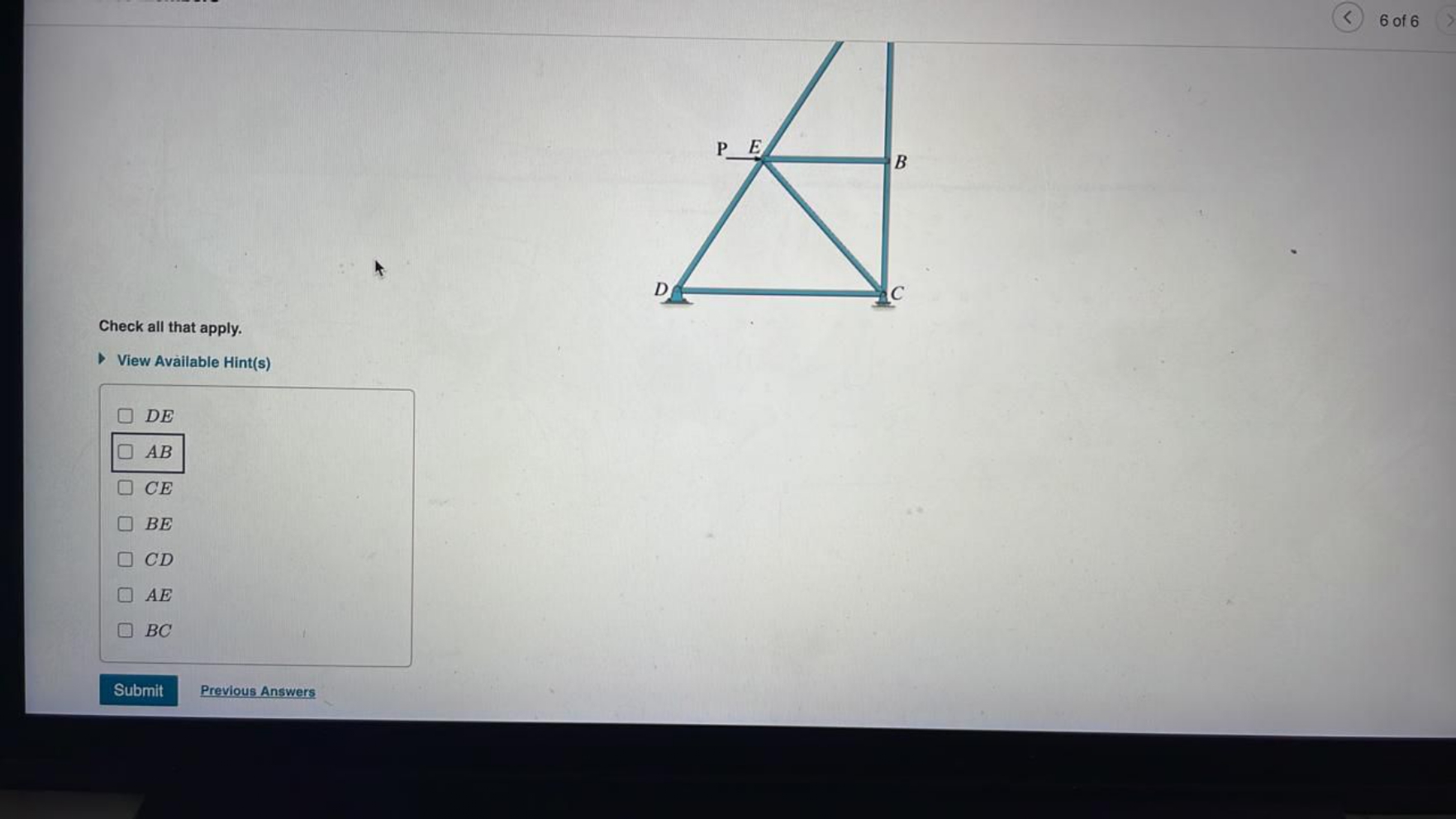
Consider the truss shown below. Identify the zero-force members.

Check all that apply.

View Available Hint(s)

DE

D AB

CE

D

E

B/nCheck all that apply.

▸ View Available Hint(s)

00

DE

AB

CE

BE

CD

AE

BC

Submit Previous Answers

D

PE

B

6 of 6/nCheck all that apply.

View Available Hint(s)

O DE

AB

CE

BE

CD

AE

BC

Submit

Previous Answers

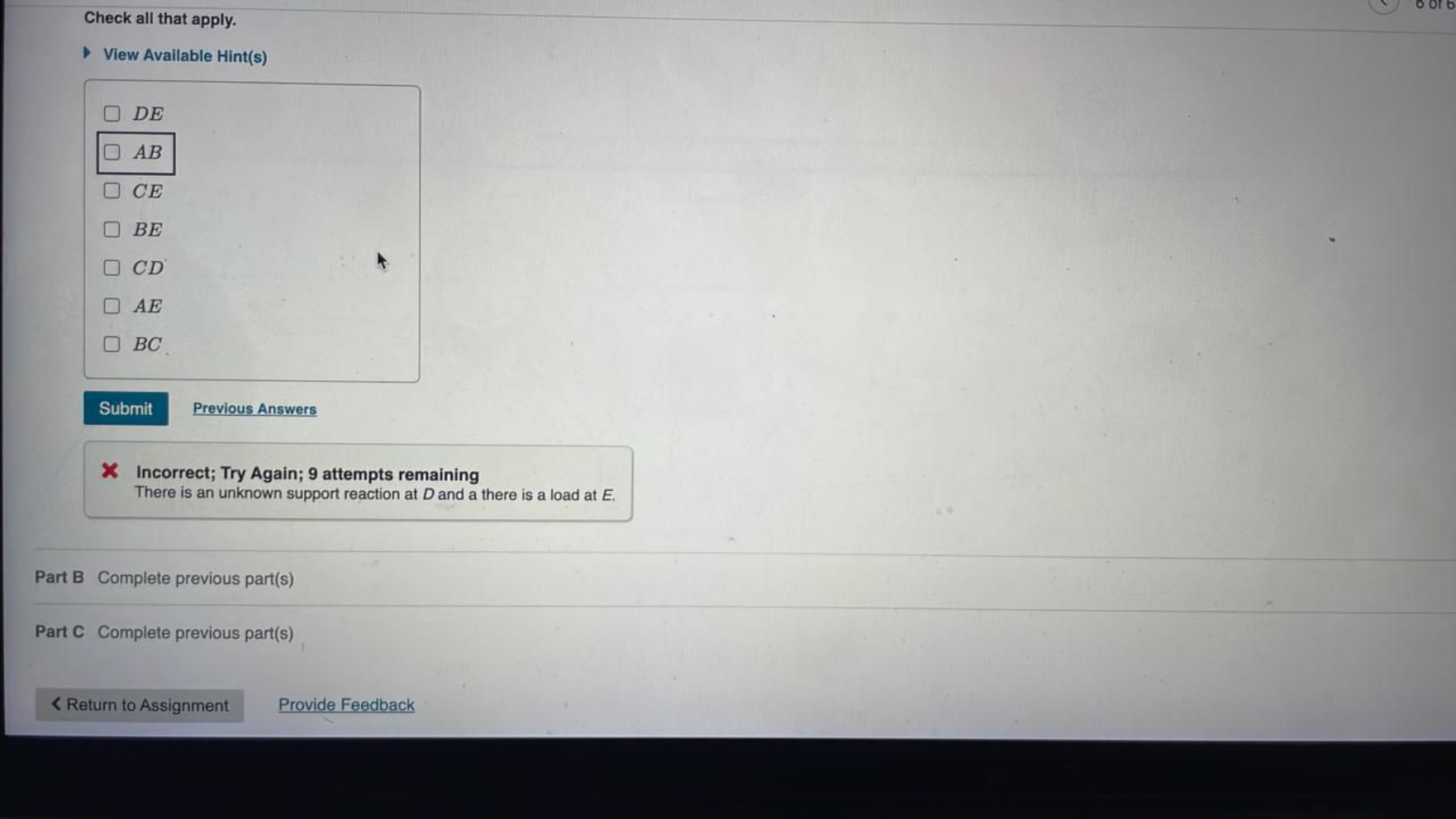
X Incorrect; Try Again; 9 attempts remaining

There is an unknown support reaction at D and a there is a load at E.

Part B Complete previous part(s)

Part C Complete previous part(s)

< Return to Assignment

Provide Feedback

k

Question image 1Question image 2Question image 3Question image 4