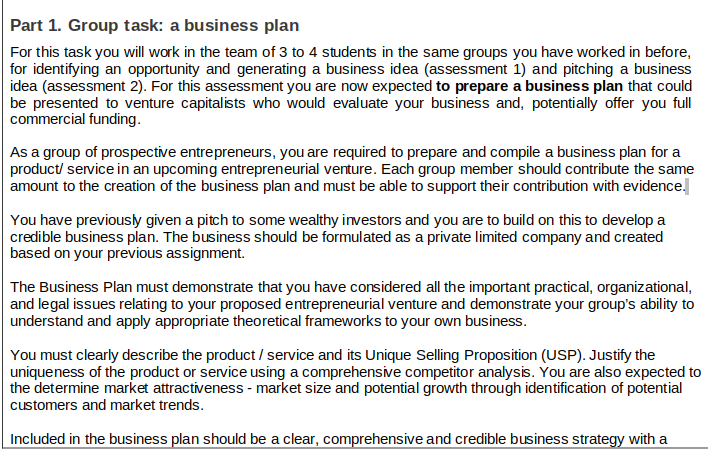
Part 1. Group task: a business plan
For this task you will work in the team of 3 to 4 students in the same groups you have worked in before,
for identifying an opportunity and generating a business idea (assessment 1) and pitching a business
idea (assessment 2). For this assessment you are now expected to prepare a business plan that could
be presented to venture capitalists who would evaluate your business and, potentially offer you full
commercial funding.
As a group of prospective entrepreneurs, you are required to prepare and compile a business plan for a
product/service in an upcoming entrepreneurial venture. Each group member should contribute the same
amount to the creation of the business plan and must be able to support their contribution with evidence.
You have previously given a pitch to some wealthy investors and you are to build on this to develop a
credible business plan. The business should be formulated as a private limited company and created
based on your previous assignment.
The Business Plan must demonstrate that you have considered all the important practical, organizational,
and legal issues relating to your proposed entrepreneurial venture and demonstrate your group's ability to
understand and apply appropriate theoretical frameworks to your own business.
You must clearly describe the product/service and its Unique Selling Proposition (USP). Justify the
uniqueness of the product or service using a comprehensive competitor analysis. You are also expected to
the determine market attractiveness - market size and potential growth through identification of potential
customers and market trends.
Included in the business plan should be a clear, comprehensive and credible business strategy with a/nclear route to commercialization. It should also identify potential risks and how you intend to manage and
mitigate these risks.
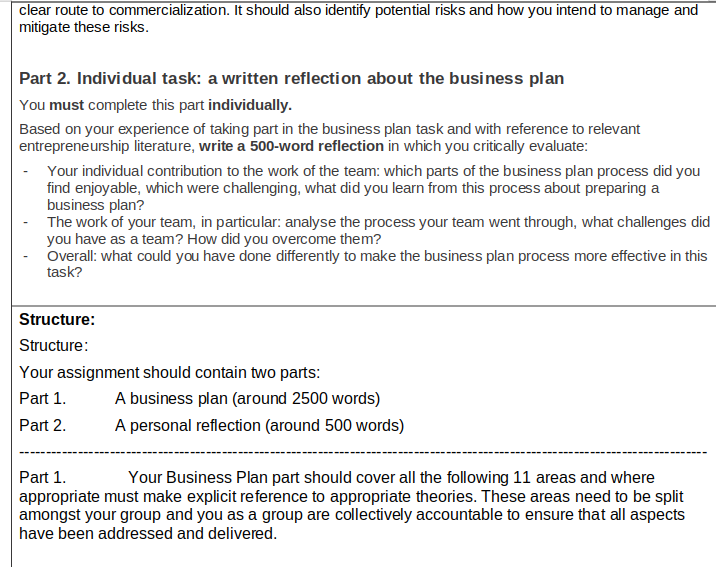
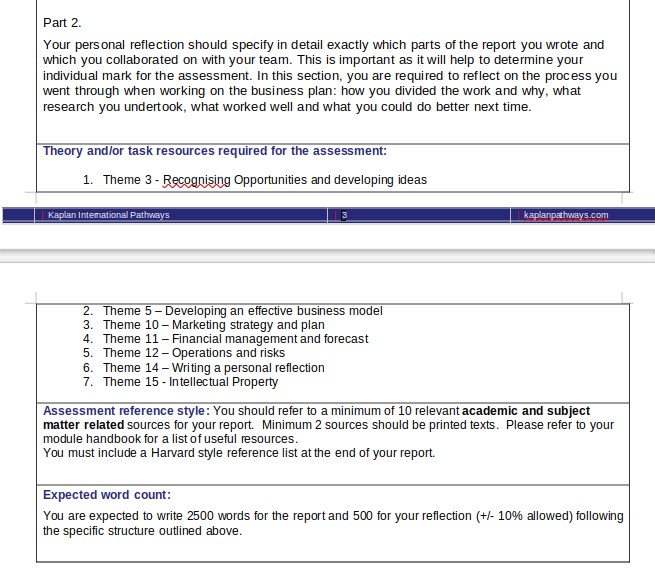
Part 2. Individual task: a written reflection about the business plan
You must complete this part individually.
Based on your experience of taking part in the business plan task and with reference to relevant
entrepreneurship literature, write a 500-word reflection in which you critically evaluate:
- Your individual contribution to the work of the team: which parts of the business plan process did you
find enjoyable, which were challenging, what did you learn from this process about preparing a
business plan?
The work of your team, in particular: analyse the process your team went through, what challenges did
you have as a team? How did you overcome them?
Overall: what could you have done differently to make the business plan process more effective in this
task?
Structure:
Structure:
Your assignment should contain two parts:
Part 1.
Part 2.
A business plan (around 2500 words)
A personal reflection (around 500 words)
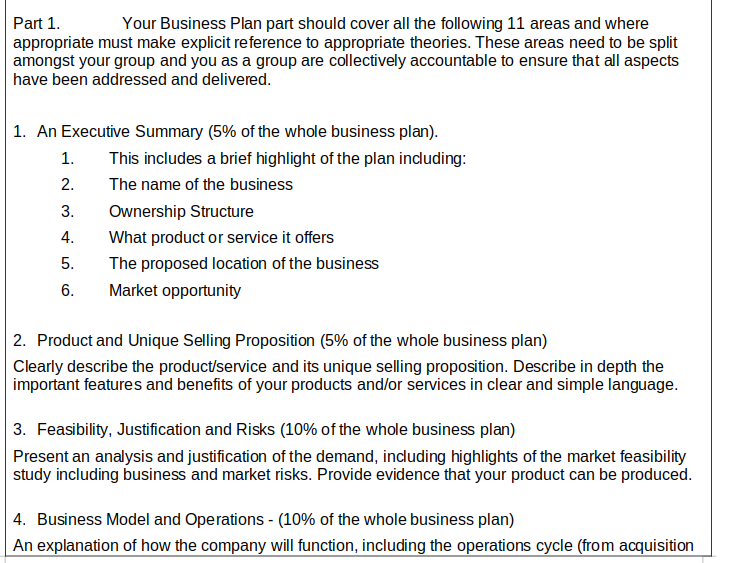
Part 1.
Your Business Plan part should cover all the following 11 areas and where
appropriate must make explicit reference to appropriate theories. These areas need to be split
amongst your group and you as a group are collectively accountable to ensure that all aspects
have been addressed and delivered./nPart 1.
Your Business Plan part should cover all the following 11 areas and where
appropriate must make explicit reference to appropriate theories. These areas need to be split
amongst your group and you as a group are collectively accountable to ensure that all aspects
have been addressed and delivered.
1. An Executive Summary (5% of the whole business plan).
This includes a brief highlight of the plan including:
The name of the business
1.
2.
3.
4.
5.
6.
Ownership Structure
What product or service it offers
The proposed location of the business
Market opportunity
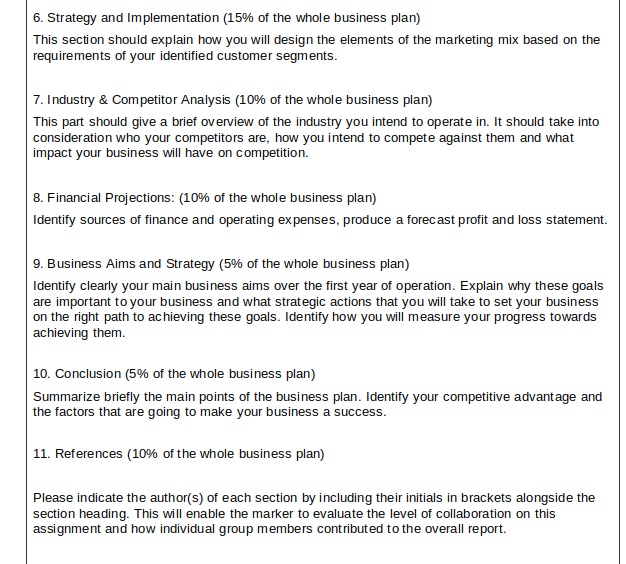
2. Product and Unique Selling Proposition (5% of the whole business plan)
Clearly describe the product/service and its unique selling proposition. Describe in depth the
important features and benefits of your products and/or services in clear and simple language.
3. Feasibility, Justification and Risks (10% of the whole business plan)
Present an analysis and justification of the demand, including highlights of the market feasibility
study including business and market risks. Provide evidence that your product can be produced.
4. Business Model and Operations - (10% of the whole business plan)
An explanation of how the company will function, including the operations cycle (from acquisition/n/n/n