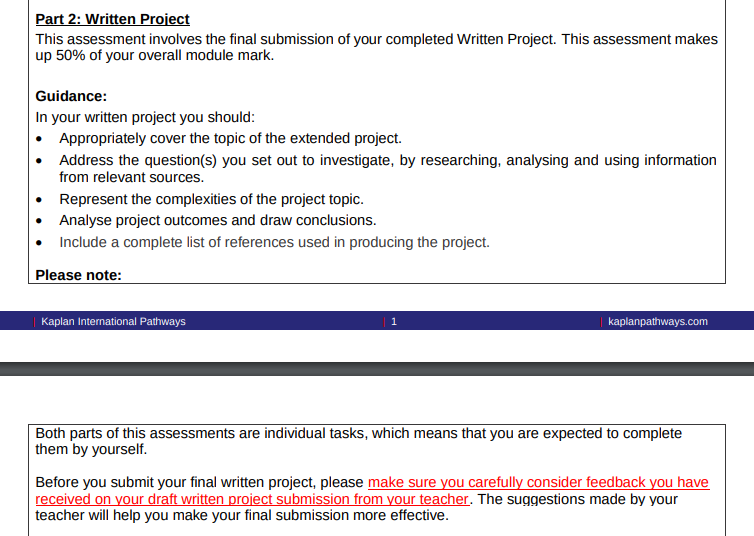
Part 2: Written Project This assessment involves the final submission of your completed Written Project. This assessment makes up 50% of your overall module mark. Guidance: In your written project you
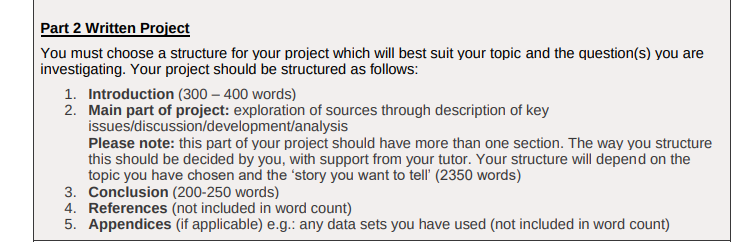
should: Appropriately cover the topic of the extended project. Address the question(s) you set out to investigate, by researching, analysing and using information from relevant sources. Represent the complexities of the project topic. Analyse project outcomes and draw conclusions. Include a complete list of references used in producing the project. Please note: Kaplan International Pathways 1 kaplanpathways.com Both parts of this assessments are individual tasks, which means that you are expected to complete them by yourself. Before you submit your final written project, please make sure you carefully consider feedback you have received on your draft written project submission from your teacher. The suggestions made by your teacher will help you make your final submission more effective./nPart 2 Written Project You must choose a structure for your project which will best suit your topic and the question(s) you are investigating. Your project should be structured as follows: 1. Introduction (300 - 400 words) 2. Main part of project: exploration of sources through description of key issues/discussion/development/analysis Please note: this part of your project should have more than one section. The way you structure this should be decided by you, with support from your tutor. Your structure will depend on the topic you have chosen and the 'story you want to tell' (2350 words) 3. Conclusion (200-250 words) 4. References (not included in word count) 5. Appendices (if applicable) e.g.: any data sets you have used (not included in word count)/nPart 2 Written Project Your grade for Part 2 will contribute 50% of your overall module mark. It will be marked using the following areas and weightings: 5. Task achievement (25%) Have you followed the instructions for producing your Written Project? Have you chosen an appropriate topic for your project? Have you investigated the topic in sufficient detail? Have you addressed all the research questions? Have you considered the topic/questions from a variety of angles? Have you formatted your project appropriately and submitted it correctly, as specified in the instructions? 6. Use of sources (25%) Have you selected relevant sources for your project and used them in your project to support your claims? Have you synthesised information from a range of sources in your project? Have you analysed the information from the sources thoroughly and linked it with your project topic? Kaplan International Pathways 7. Structure (20%) Have you organised your project clearly into sections and arranged them in a logical order? Have you linked the ideas in your paragraphs? Do you use signposting language effectively? 8. Academic Integrity (15%) kaplanpathways.com Is your paraphrasing/summarising successful in terms of retention of meaning? Have you included an accurate citation with each paraphrase/summary? Are all quotes (if used) correctly marked? Do you have a full list of matching references which are correctly formatted (including organisation in alphabetical order and NO bullet points or numbering)? Are all facts/data presented genuine, accurate and precise? 9. Clarity of expression (15%) Have you checked the accuracy of your written language? Have you explained complicated concepts to help your reader? Have you used topic-specific vocabulary accurately? You will receive a % mark in each of these categories. The overall mark will be a percentage (0-100%)./n2 Introduction Over a century, important turning points in the history of aerospace innovation have transformed the skies above industry below. Presently, the industry is at the forefront of technological innovation, emphasizing the improvement of performance, efficiency, and safety through state-of-the-art innovations. The purpose of this report is to investigate how aerospace advancements can be applied to shape the future. We investigate how advances in materials science, manufacturing processes, and artificial intelligence (Al) are transforming the aerospace sector and beyond. Background Information on Aerospace Innovations There have been several significant historical tuming points in the intriguing journey of aerospace developments. The Wright brothers' successful powered flight in 1903 is considered the beginning of aviation. But it wasn't until the middle of the 20th century that the aerospace industry saw several notable breakthroughs that opened up new possibilities. Aerospace technology underwent a boom of improvements following the end of World War II. In order to increase speed and efficiency, military aircraft powered by piston engines were switched to jet engines during the conflict. This change paved the way for improvements in civilian aviation. In the 1950s, the military began developing small jet-powered aircraft for VIP transport. Learjet and Dassault Falcon were among the pioneering companies introducing private jets in the early 1960s, revolutionizing executive transportation. The introduction of the Boeing 747 in the 1970s marked a turning point in private and commercial air travel. With its expansive size and luxurious amenities, the 747 offered unprecedented comfort and convenience for private fliers, including heads of state and celebrities. Aerospace technology has undergone remarkable advancements over the decades, enhancing safety, efficiency, and comfort in private flying. The introduction of jet engines, which provide simplicity, dependability, and improved performance over piston engines, changed aircraft propulsion. The creation and broad application of GPS technology transformed aviation navigation. GPS replaced traditional ground- based navigation by improving aircraft safety, efficiency, and precision with pinpoint accuracy and real-time positional data Grady (2018)./nAerospace Innovations & Applications In order to improve performance, efficiency, and safety, the aerospace industry is at the forefront of technical innovation, continuously pushing the limits of materials and production processes. Two main areas of interest have surfaced in recent years: the investigation of lightweight materials for improved fuel efficiency and the use of additive manufacturing for quick prototyping and customization. Not only can lightweight materials save gasoline, but they also improve performance and payload capacity. High strength and stiffness CFRP composite materials are among the cutting-edge materials being investigated; these properties make them perfect for use in aeronautical applications. They are lighter than traditional materials like aluminum and offer excellent fatigue resistance. MMCs combine lightweight metals with ceramic reinforcements, resulting in materials that are both strong and lightweight. Intermetallic compounds offer superior strength and corrosion resistance compared to conventional alloys (Portolabs Manufacturing Accelerated 2021). The aircraft sector has experienced a change because of additive manufacturing (AM), sometimes referred to as 3D printing, which offers quick prototype and customization options. Engineers may design complicated interior structures and intricate geometries with additive manufacturing (AM) that are hard or impossible to accomplish with conventional manufacturing techniques. Engineers may test ideas and iterate designs more quickly with additive manufacturing (AM) before moving forward with full-scale production. Additionally, AM makes it possible to produce bespoke parts on demand that are suited to certain aircraft configurations or mission requirements. By leveraging lightweight materials and additive manufacturing technologies, aerospace companies can achieve significant improvements in fuel efficiency, performance, and operational flexibility, ensuring a sustainable and competitive future for the industry (Crawford, 2017). Autonomous drones represent a significant advancement in aviation technology, leveraging Al integration to achieve various objectives across industries. Autonomous drones equipped with Al integration are revolutionizing surveillance and security operations. These drones can autonomously patrol predefined areas, analyze live video feeds in real-time using computer vision algorithms, and identify potential security threats or anomalies. Al algorithms play a critical role in predictive/nmaintenance strategies with in the aviation industry, enabling proactive identification of potential equipment failures or maintenance issues before they occur. By analyzing vast amounts of sensor data and historical maintenance records, these algorithms can predict component failures, optimize maintenance schedules, and prevent costly unplanned downtime (Shah, Trivedi, & Tank, 2022). By detecting early warning signs such as abnormal vibrations, temperature fluctuations, or wear and tear, these algorithms can alert maintenance teams to take preemptive action, thereby reducing the likelihood of unscheduled maintenance events and optimizing asset reliability. Conclusion Aeronautics manufacturing faces significant challenges and ethical considerations. Ethical dilemmas emerge with Al integration, posing questions about accountability, and data privacy. The aerospace industry continues to soar on wings of innovation, driven by material advancements, manufacturing techniques & Al integration. From lightweight materials to additive manufacturing drones, each innovation reshapes the future of flight, promising enhanced efficiency, safety & sustainability.