Q1. Find out what the names of the forces acting on an airplane are and describe these
forces in your own words.
Q2. Find out which forces are responsible for the tides of the oceans. Describe these forces
and their effect on the ocean here.
Q3. Do some research and find out which of the forces listed above are contact forces and
which forces are non-contact forces or forces acting at a distance./nQ4. Answer all parts to this question.
1. Which has more inertia, a passenger car traveling down the road or a
freight train moving at the same speed? What do you think this means
about the amount of force required to bring each to a stop?
2. Which requires more effort to start rolling from rest, a golf ball or a
bowling ball? Explain your answer in terms of inertia, acceleration and
force.
3. A person is riding a bicycle down a flat road in a straight line. Describe
what will happen to the motion when the bicycle's breaks are applied. Be
sure to include net force, acceleration, and inertia in your description.
4. Friction is a net force that stops and/or slows many everyday objects.
Describe one situation where friction acts upon an object. Be sure and
mention inertia, acceleration, friction, and net force in your description./nQ5. Two cars have the same engine and wheels. It is determined experimentally that
both cars produce the same force over a 100 meter course. Car A can accelerate
twice as fast as Car B. Explain this result using Newton's Second Law.
Q6. Michele kicks a 0.75 kg ball with a 45 N force. What is the acceleration of the
ball? SHOW WORK
Q7. Fill in the blanks in the table below, submit your results in the text box by letter
[3(a), (b), (c), etc.]: SHOW WORK/nQ8. Explain in your own words what action/reaction pair is acting to help you walk.
Describe magnitudes and directions of these two forces. Make a sketch that shows
the forces as vectors, i.e. as arrows.
Q9. Explain the action/reaction pair that is acting to allow the rolling motion of the
tires of a car.
Q10. Draw vectors on the objects in this figure to indicate the forces that are acting
on them. Identify at least two action/reaction pairs in the figure./nQ11. A person has a mass of 70 kg. What is this person's weight? What is the force that this
person exerts onto the Earth? What is the Earth's acceleration because of this person?
SHOWALL WORK
Q12. How big is a Moon? How big is amars? What is therefore the weight of the person from Q11
on the Moon? What is the person's weight on Mars? SHOW WORK
Q13. Find out what the conversion between pounds (lbs) and newtons is and give it here.
What is the weight of the person from Q11 in pounds on the Earth? What is the weight of the
person from Q11 in pounds on the Moon and on Mars? SHOW WORKQ14. Describe the
motion of a swimmer accelerating forward in the water in terms of action and reaction forces.
Q15. On a cold winter day, a car tries to get moving on an icy road but does not get
anywhere. What happens? Explain it in terms of forces and motion.
Q16. A person pushes against a wall. Assuming the wall does not move, describe the equal
and opposite forces involved.
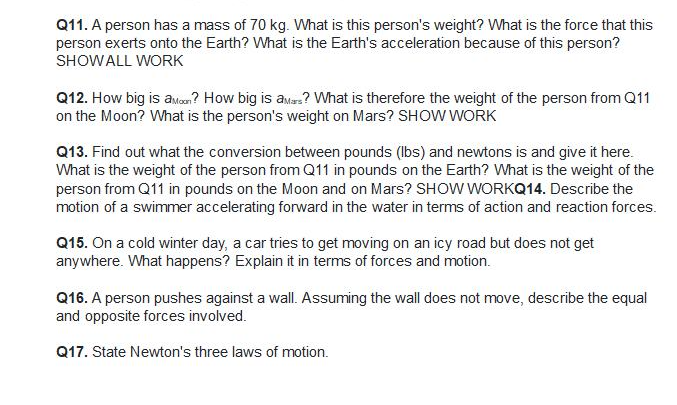
Q17. State Newton's three laws of motion./nQ1. Take a look at the following graph of a ball in motion. Given your understanding
of Distance - Time graphs, displacement, and origin describe the ball's motion.
6
Position (m)
N
0
0
5
Time (s)
10
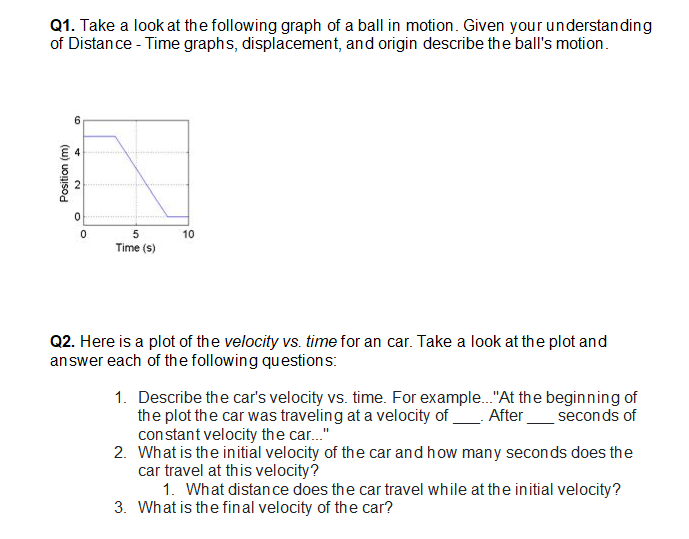
Q2. Here is a plot of the velocity vs. time for an car. Take a look at the plot and
answer each of the following questions:
1. Describe the car's velocity vs. time. For example...."At the beginning of
the plot the car was traveling at a velocity of After seconds of
constant velocity the car..."
2. What is the initial velocity of the car and how many seconds does the
car travel at this velocity?
1. What distance does the car travel while at the initial velocity?
3. What is the final velocity of the car?/nVelocity (m/s)
22
20
10
16
14
12
10
0
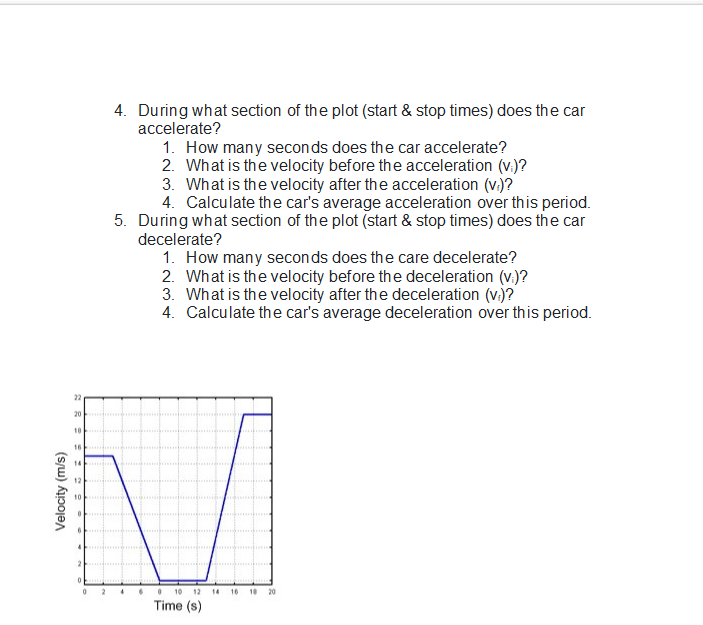
4. During what section of the plot (start & stop times) does the car
accelerate?
1. How many seconds does the car accelerate?
2. What is the velocity before the acceleration (v.)?
3. What is the velocity after the acceleration (v.)?
4. Calculate the car's average acceleration over this period.
5. During what section of the plot (start & stop times) does the car
decelerate?
2 4
6
1. How many seconds does the care decelerate?
2. What is the velocity before the deceleration (V.)?
3. What is the velocity after the deceleration (v.)?
4. Calculate the car's average deceleration over this period.
0 10 12 14 16
Time (s)
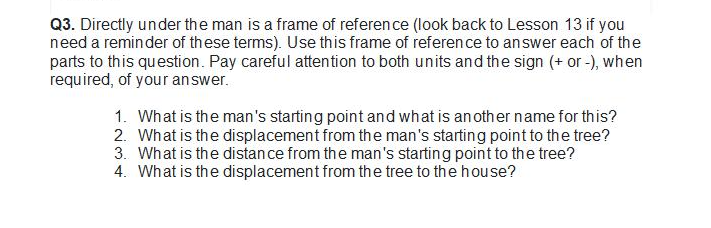
10 20/nQ3. Directly under the man is a frame of reference (look back to Lesson 13 if you
need a reminder of these terms). Use this frame of reference to answer each of the
parts to this question. Pay careful attention to both units and the sign (+ or -), when
required, of your answer.
1. What is the man's starting point and what is another name for this?
2. What is the displacement from the man's starting point to the tree?
3. What is the distance from the man's starting point to the tree?
4. What is the displacement from the tree to the house?/nQ4. Make a screenshot after you pause the simulation (when the man is home). Paste this
into a document you can submit for this assignment. Does your answer agree with the one
we calculated in "Practice Problem 2"?/nAfter you have copied the screenshot for the simulation above. Copy and Paste the questions below into Section 3-Result your Lab Report Label this Simulation 2
Q5. Answer each part of this question after running each of the two simulations
above.
1. Approximately how long did the man get home in the second
simulation?
2. Describe any differences in how the man moved that you saw in each of
the two simulations.
3. Describe any difference in the position plot between these two
simulations. Explain why it is different.
4. Describe any difference in the velocity plot between these two
simulations. Explain why it is different.
5. In the second simulation the man's initial velocity was 0 m/s compared
to 1 m/s in the first simulation. Even though the man was not moving at
the beginning of the second simulation he arrived home faster. Explain
in your own words how this happens (hint: remember to mention the
velocity and acceleration in your answer).