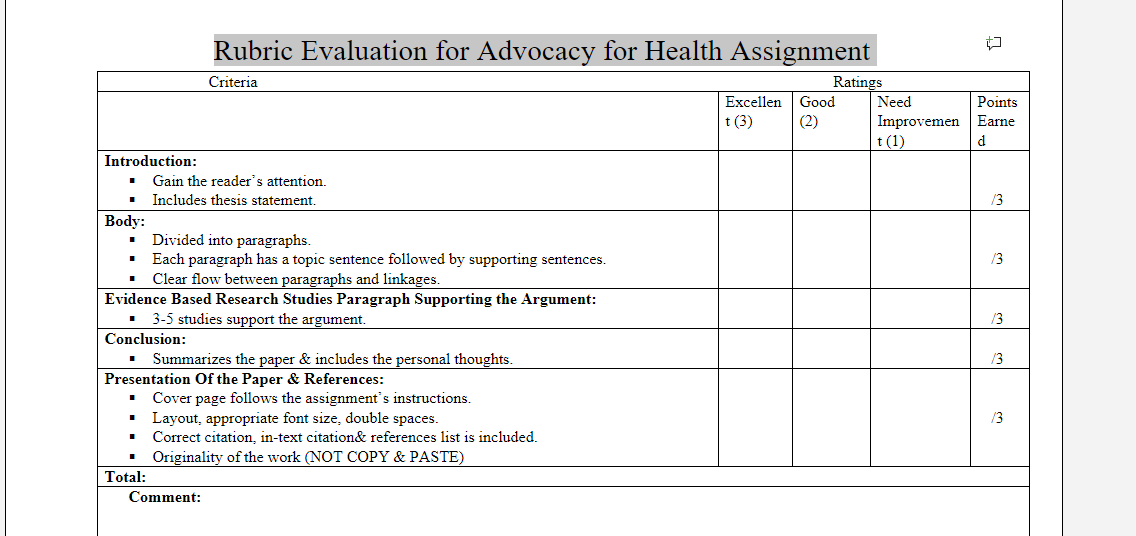
Rubric Evaluation for Advocacy for Health Assignment
Advocacy Paper Assignment’s instructions:
List of Assigned Topics (Already distributed into students’ groups):
Privacy in healthcare
Patient Education
Mental health
Cancer
Environmental Health
Nutrition and Weight Status
Tobacco Use
Physical Activity
Child health
It should be typed using double-spaced 12-point font, Times New Roman, be grammatically correct, and free of typographical errors. Also, submit it as a word document.
It follows the APA 6th edition style guidelines. Particularly, APA-Intext citation & APA References. Please open the attached file for APA-style instructions.
https://owl.excelsior.edu/citation-and-documentation/apa-style/apa-in-text-citations/
https://owl.excelsior.edu/citation-and-documentation/apa-style/apa-references/
The first page is the cover page that includes the main title (Advocacy in Health, and subtitle (provided topics to the students’ groups), department name, course number, student name, ID number, name of the course instructor, and the due date for the assignment (13/11/2022).
It has to be 3-5 pages, NOT including the cover page and the references page.
It follows the academic style of writing an essay that includes an introduction part, body part, and conclusion part.
Every paragraph should have one topic sentence followed by supporting sentences.
Each paragraph must be between 4-6 sentences. (Up to 8 sentences if there are more than subtitles).
The introduction must include a thesis statement that explains what you are going to talk about in your topic. E.g., “For this assignment, I will identify three different health communication objectives listed by Healthy People 2020. I will discuss the importance of the health communications objectives that I selected and, by using personal experience, expound on the topics to support my choices.”
The paper should begin with an overview of advocacy in health and its role in the community. Followed by an overview of the subtopic and its importance (the assigned topics). Advocacy in health inspires action and motivates change. Advocacy has the power to make a difference. Also, you should include innovative strategies for your advocacy of interest.
Follow the 6 steps to create a concise, strong advocacy message for any audience:
1. Open with a statement that engages your audience.
Make a statement that gets your audience’s attention right away, perhaps using a dramatic fact. This is your lead-in and should be only a sentence or two.
2. Present the problem.
Describe the problem, who it affects, its impact.
3. Provide facts and data about the problem.
Data is important to demonstrate that a problem exists and to support your argument. Look for facts that are relevant to your audience.
4. Share a story or give an example of the problem.
An example or story puts a human face on the issue and makes it real and more compelling. Again, make sure the example is relevant to your audience.
5. Connect the issue to the audience’s values, concerns, or self-interest.
Show your audience how this interest fits with what they care about, want, or need. Learn what you can about the person. For example, people tend to value their children, so you advocate for a better strategy to promote health in children.
6. Make your request,
Clearly state what you want the person to do.
Also, it must include the supporting evidence-based research studies to support your argument as a separate paragraph before the conclusion part. In this part, you can include 3-5 studies that support your argument.
It should include a conclusion part that summarizes the paper and provide some personal thoughts about the topic.
The last part is the references list.
All work must be original to this course. Please pay attention to the risk of plagiarism. (COPY AND PASTE ARE NOT ALLOWED)
Recommended resources:
https://pubmed.ncbi.nlm.nih.gov/
https://www.who.int/
https://academics.otc.edu/library/allied-health/
https://www.apha.org/
https://www.himss.org/
https://www.cdc.gov/