search
Business Plan Video Week 3 (Instructions and Assignment)
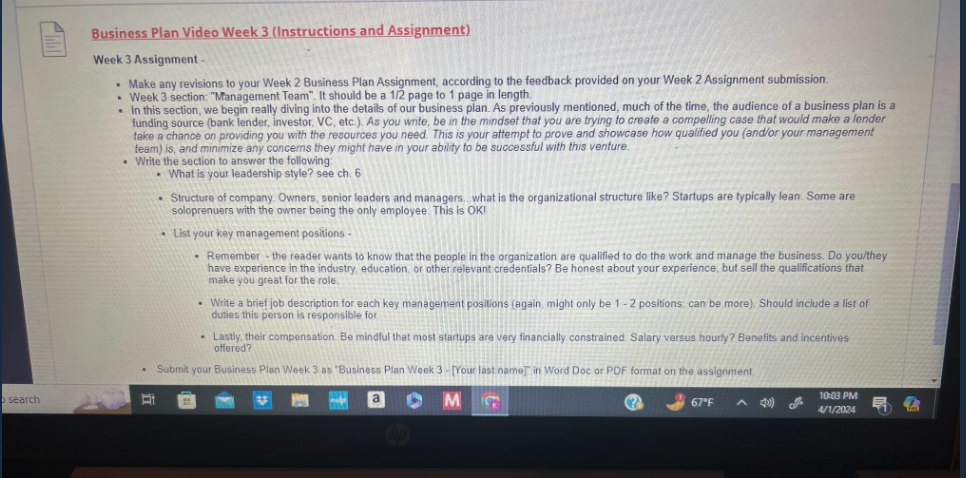
Week 3 Assignment-
Make any revisions to your Week 2 Business Plan Assignment, according to the feedback provided on your Week 2 Assignment submission.
Week 3 section: "Management Team". It should be a 1/2 page to 1 page in length.
In this section, we begin really diving into the details of our business plan. As previously mentioned, much of the time, the audience of a business plan is a
funding source (bank lender, investor, VC, etc.). As you write, be in the mindset that you are trying to create a compelling case that would make a lender
take a chance on providing you with the resources you need. This is your attempt to prove and showcase how qualified you (and/or your management
team) is, and minimize any concerns they might have in your ability to be successful with this venture.
Write the section to answer the following:
What is your leadership style? see ch. 6
Structure of company. Owners, senior leaders and managers. what is the organizational structure like? Startups are typically lean. Some are
soloprenuers with the owner being the only employee. This is OK!
List your key management positions-
Remember the reader wants to know that the people in the organization are qualified to do the work and manage the business. Do you/they
have experience in the industry, education, or other relevant credentials? Be honest about your experience, but sell the qualifications that
make you great for the role.
•Write a brief job description for each key management positions (again, might only be 1-2 positions: can be more). Should include a list of
duties this person is responsible for
Lastly, their compensation. Be mindful that most startups are very financially constrained. Salary versus hourly? Benefits and incentives
offered?
Submit your Business Plan Week 3 as "Business Plan Week 3 [Your last name] in Word Doc or PDF format on the assignment
a
CMG
67°F 14)
10:03 PM
4/1/2024/n 1/1
Week 2: Company/Industr
Legal Form of Business: Jen Haven Farms will work as a sole ownership.
oversaw by [YourName]
Dimed and
Required Licences, Permits, or Cortifications- To work, Green Haven Farms will require licenses
and allow connections with agribusiness, land use, and food taking care of. This incorporates
licenses for farming exercises, drafting endorsements, and food handling affirmations.
Product/Service-Selection-and-Differentiatore: The products presented by Green Haven Farms
will be organic organic products, vegetables, spices, and blossoms developed utilizing feasible
farming rehearsals (Sashika et al., 2024). The ranch will separate itself from competitors by
zeroing in on great, privately obtained produce, giving customized client assistance, and
executing harmless to the ecosystem developing methods.
Industry Green Haven Farms will work in the organic farming industry, which is encountering
consistent development because of expanding purchaser interest for sound and economically
created food (Bisht et al., 2022).
Major-Competitors and Competitive Advantages. Major competitors incorporate other
neighborhood organic homesteads and customary supermarkets that offer organic produce.
Opportunities for Growth-There are a few opportunities for development, including extending
product contributions to incorporate worth added products like jams, pickles, and organic teas.
increasing creation to fulfill developing needs, and investigating new business sectors through
internet based deals and companies with nearby eateries and food retailers.
a M Business plan organic urban
farming Initiative
Business Name: Green Haven farms.
Address: 123 main Street Anytown, USA.
Phone #: (555) 555-5555
Date plan issued: March 13th 2024
This bmunity:
rod
गत
plan Contains confidential
information and is intended solely for
the use of the recepient named herein
It may not be produced, distributed,
or used for any purpose other than
without the Agonysiness Venture
express written
Consent of Green Haven farm.
Benefits of community.
Green Haven Farms will stimulate monomic
growth by providing employment
Opportinithar for love! residents.
Although, business expands it will create
jobb in Vanour Sectors including
distribution, and Marketing.
farming,/n 6-5 Leadership
Learning Objective 6-5
Identify the different types of leadership.
AAA
Leadership has been defined broadly as the ability to influence others. Leadership is different from
management in that a leader strives for voluntary cooperation, whereas a manager may have to
depend on coercion to change employee behavior.
ΠΕ
meky
a
M
Tem...
^ 4) & Chapter 06 Understanding the Management Process
th
AA B
6-5a Formal and Informal Leadership
Some experts make distinctions between formal leadership and informal leadership. Formal leaders
have legitimate power of position. They have authority within an organization to influence others to
work toward the organization's objectives. Informal leaders usually have no such authority and may
or may not exert their influence in support of the organization. Both formal and informal leaders
make use of several kinds of power, including the ability to grant rewards or impose punishments,
the possession of expert knowledge, and personal attraction or charisma. Informal leaders who
identify with the organization's goals are a valuable asset to any organization. However, a business
can be greatly hampered by informal leaders who turn werk groups against management.
I
How Good Are Your Managerial Skills?
To be successful, managers must master and simultaneously utilize a number of skills. These
4
40
%
5
164-
A
6
4+
&
88
7
144
*
8
a
M
hp
114
(
Tem...
4)
10:11 PM
4/1/2024
>
10
fil
f12
441
insert
prt sc
e
delete
home
end
pg up
6
)
O
E
R
T
Y
U
-
O
D
F
G
H
J
K
L
C
V
B
N
M
A
P
alt
ctrl
+
L
backspace
t
J
pause
enter
num
lock
7
home
00+
TA
4
5
LO
↑ shift
1
end
pg
2+ lawba Va...
Enrollment | Federal...
My Courses
Black...
MyCVCC Portal
Ca...
Class Financial and...
MindTap - Cengage...
GAGE MINDTAP
Q
hapter 06 Understanding the Management Process
AA 1
6-5b Styles of Leadership
For many years, finding a consensus on the most important leadership traits was difficult.
Leadership was viewed as a combination of personality traits, such as self-confidence, concern for
people, intelligence, and dependability. In recent years, the emphasis has been on styles of
leadership. Several styles have emerged, including autocratic, participative, laissez-faire,
transformational, transactional, and charismatic.
Autocratic leadership, also called authoritative leadership, is a hands-on, task-oriented leadership
style. These leaders make decisions unilaterally, with little concern for employee opinions or
knowledge. Employees are told exactly what is expected from them and given specific guidelines,
rules, and regulations on how to achieve their tasks. Strict compliance is expected.
Participative leadership, which involves all members of a team identifying essential goals and
developing strategies to reach those goals, is common in today's business organizations.
5
Ft
R
a
M
hp
fg
10
▷11
50
%
5
16
A-
A
6
4+
&
7
144
*
8
LL
AAI
6
f11
12.
insert
prt sc
+
{
T
Y
U
O
P
[
G
H
K
B
N
M
C
10:1
66°F
4/1
t
delete
home
backspace
num
lock
pause
enter
home
1 shift apart=5910754&#
wba Va... 1st Enrollment | Federal... My Courses-Black...
MyCVCC Portal - Ca...
Class Financial and...
MindTap - Cengage...
AGE MINDTAP
Q Se
apter 06 Understanding the Management Process
AA.
Participative leaders consult workers before making decisions and make final decisions based on
their support, though they retain final authority for decision making. This helps workers understand
which goals are important and fosters a sense of ownership and commitment to reach them.
Communication is open up and down the hierarchy. Coaching, collaborating, and negotiating are
important skills for participative leaders.
Laissez-faire leadership, also known as free-rein leadership, is a hands-off leadership style. These
leaders provide general direction along with tools and resources and then delegate responsibility
and decision making to subordinates. As long as employees are satisfying expectations, these leaders
expect them to apply their own skills and knowledge to furthering the goals of the organization.
Warren Buffett, CEO and chief investor of Berkshire Hathaway, is a famously laissez-faire leader.
Transformational leadership recognizes that today's competitive landscape requires challenging
the status quo with new ideas. These leaders promote communication and transparency with high
expectations while providing support and recognition to subordinates. Many of the industry
D
40
16
5
9
17
+4
18
144
fg
&
7
*
8
a
M
hp
114
R
T
G
Y
H
U
BN M
10
6
144
f11
口
O
f12
insert
prt sc
O
P
K
V
C
66°F
4))
10:12 PM
4/1/2024
delete
home
end
+
num
t backspace
lock
enter
home
pause
↑ shift 69
AGE MINDTAP
apter 06 Understanding the Management Process
4
Ca...
Class Financial and...
MindTap - Cengage...
Q Search t
disruptors of recent years, including Google's Larry Page and Dollar Shave Club's Michael Dubin,
provided transformational leadership to develop new business models.
Transactional leadership is a leadership style that emphasizes structure, monitoring employee
performance, and using rewards and punishments to motivate subordinates to achieve
organizational goals. These leaders tend to focus on the chain of command, productivity, and
efficiency. They generally try to be considerate of subordinates because doing so can improve
productivity. Transactional leadership is especially common in sports teams though it is often found
in business organizations as well.
Finally, charismatic leadership is personality dependent. These leaders influence, inspire, and
motivate employees to perform due to their own innate charm and personality. They tend to be
idealistic and forward-thinking and model behavior that reflects their high expectations. Oprah
Winfrey and the late Steve Jobs are well-known examples of charismatic leaders who inspired their
subordinates to perform very well in competitive industries.
40
%
5
^
+4
f8
144
&
*
6
8
00
R
T
Y
19
▷ll
a
M
hp
110
O
144
O
LL
F
G
H
J
K
L
V
V
B
N
M
AA B
66°F
10:12 PM
4/1/2024
f11
112 insert
prt sc
delete
home
end
pg up
O
P
?
A
aft
ctri
+
=
backspace
t
enter
pause
↑ shift
num
lock
7
home
47
1
end
5