Submission instructions:
You are required to provide the source code including concise instructions on how to build and run
the software and the unit tests. All build time and run time dependencies should be provided in the
form of Docker containers so that the GTA doesn't have to install anything other than Docker. In
addition to the code and instructions, you must also turn in a report that describes your submission.
This report should include a description of how your code works, the design of your regular
expressions, any assumptions you have made, and the pros/cons of your approach./nTo provide an opportunity to demonstrate other skills learned this semester, the following are
additional requirements that must be met:
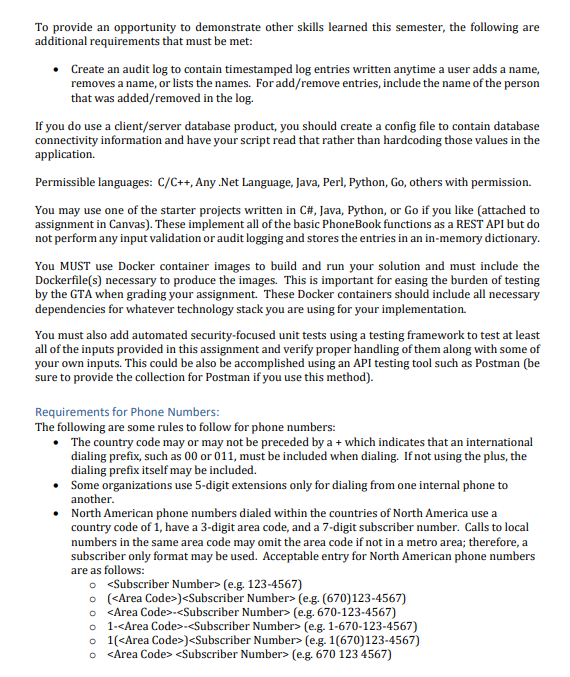
• Create an audit log to contain timestamped log entries written anytime a user adds a name,
removes a name, or lists the names. For add/remove entries, include the name of the person
that was added/removed in the log.
If you do use a client/server database product, you should create a config file to contain database
connectivity information and have your script read that rather than hardcoding those values in the
application.
Permissible languages: C/C++, Any .Net Language, Java, Perl, Python, Go, others with permission.
You may use one of the starter projects written in C#, Java, Python, or Go if you like (attached to
assignment in Canvas). These implement all of the basic PhoneBook functions as a REST API but do
not perform any input validation or audit logging and stores the entries in an in-memory dictionary.
You MUST use Docker container images to build and run your solution and must include the
Dockerfile(s) necessary to produce the images. This is important for easing the burden of testing
by the GTA when grading your assignment. These Docker containers should include all necessary
dependencies for whatever technology stack you are using for your implementation.
You must also add automated security-focused unit tests using a testing framework to test at least
all of the inputs provided in this assignment and verify proper handling of them along with some of
your own inputs. This could be also be accomplished using an API testing tool such as Postman (be
sure to provide the collection for Postman if you use this method).
Requirements for Phone Numbers:
The following are some rules to follow for phone numbers:
• The country code may or may not be preceded by a + which indicates that an international
dialing prefix, such as 00 or 011, must be included when dialing. If not using the plus, the
dialing prefix itself may be included.
• Some organizations use 5-digit extensions only for dialing from one internal phone to
another.
• North American phone numbers dialed within the countries of North America use a
country code of 1, have a 3-digit area code, and a 7-digit subscriber number. Calls to local
numbers in the same area code may omit the area code if not in a metro area; therefore, a
subscriber only format may be used. Acceptable entry for North American phone numbers
are as follows:
o (e.g. 123-4567)
o () (e.g. (670)123-4567)
o - (e.g. 670-123-4567)
o 1-- (e.g. 1-670-123-4567)
o 1() (e.g. 1(670)123-4567)
o (e.g. 670 123 4567)/nThe goal of this assignment is to produce a REST API that validates its input using regular
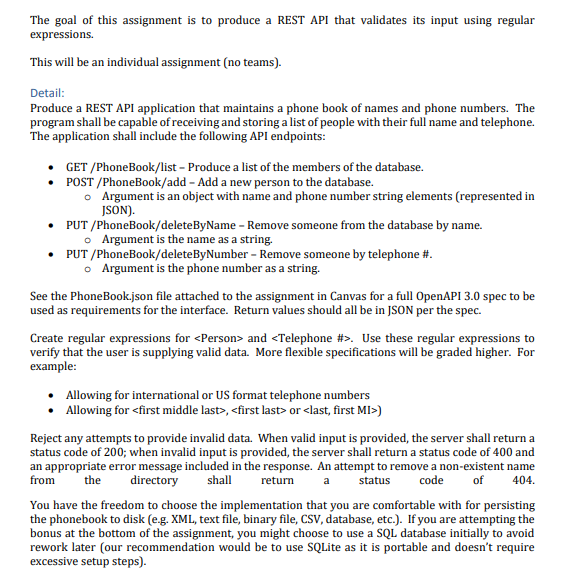
expressions.
This will be an individual assignment (no teams).
Detail:
Produce a REST API application that maintains a phone book of names and phone numbers. The
program shall be capable of receiving and storing a list of people with their full name and telephone.
The application shall include the following API endpoints:
GET /PhoneBook/list - Produce a list of the members of the database.
• POST /PhoneBook/add - Add a new person to the database.
o Argument is an object with name and phone number string elements (represented in
JSON).
PUT /PhoneBook/delete ByName - Remove someone from the database by name.
o Argument is the name as a string.
PUT /PhoneBook/delete ByNumber - Remove someone by telephone #.
o Argument is the phone number as a string.
See the PhoneBook.json file attached to the assignment in Canvas for a full OpenAPI 3.0 spec to be
used as requirements for the interface. Return values should all be in JSON per the spec.
Create regular expressions for and . Use these regular expressions to
verify that the user is supplying valid data. More flexible specifications will be graded higher. For
example:
Allowing for international or US format telephone numbers
Allowing for , or )
Reject any attempts to provide invalid data. When valid input is provided, the server shall return a
status code of 200; when invalid input is provided, the server shall return a status code of 400 and
an appropriate error message included in the response. An attempt to remove a non-existent name
from
shall return a status code of 404.
the
directory
You have the freedom to choose the implementation that you are comfortable with for persisting
the phonebook to disk (e.g. XML, text file, binary file, CSV, database, etc.). If you are attempting the
bonus at the bottom of the assignment, you might choose to use a SQL database initially to avoid
rework later (our recommendation would be to use SQLite as it is portable and doesn't require
excessive setup steps).