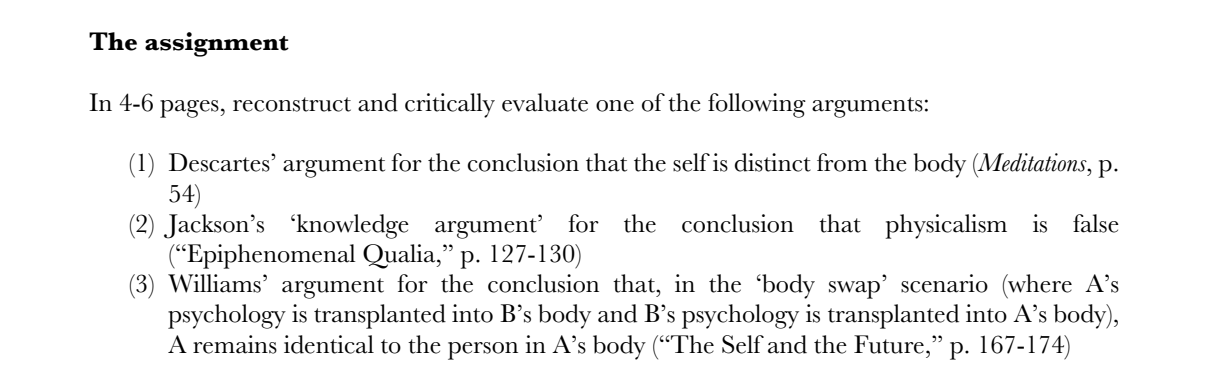
The assignment In 4-6 pages, reconstruct and critically evaluate one of the following arguments: (1) Descartes' argument for the conclusion that the self is distinct from the body (Meditations, p. 54)
(2) Jackson's knowledge argument for the conclusion that physicalism is false ("Epiphenomenal Qualia,” p. 127-130) (3) Williams' argument for the conclusion that, in the body swap' scenario (where A's psychology is transplanted into B's body and B's psychology is transplanted into A's body), A remains identical to the person in A's body ("The Self and the Future," p. 167-174)/n DUKE UNIVERSITY PRESS The Self and the Future Author(s): Bernard Williams Source: The Philosophical Review, Apr., 1970, Vol. 79, No. 2 (Apr., 1970), pp. 161-180 Published by: Duke University Press on behalf of Philosophical Review Stable URL: https://www.jstor.org/stable/2183946 JSTOR is a not-for-profit service that helps scholars, researchers, and students discover, se, and build upon wide range of content in a trusted digital archive. We use information technology and tools to increase productivity and facilitate new forms of scholarship. For more information about JSTOR, please contact support@jstor.org. Your use of the JSTOR archive indicates your acceptance of the Terms & Conditions of Use, available at https://about.jstor.org/terms J JSTOR Duke University Press and are collaborating with JSTOR to digitize, preserve and extend access to The Philosophical Review This content downloaded from 142.150.190.39 on Mon, 05 Feb 2024 18:03:46 +00:00 All use subject to https://about.jstor.org/terms THE SELF AND THE FUTURE SUR UPPOSE that there were some process to which two persons, A and B, could be subjected as a result of which they might be said—question-beggingly—to have exchanged bodies. That is to say-less question-beggingly-there is a certain human body which is such that when previously we were confronted with it, we were confronted with person A, certain utterances coming from it were expressive of memories of the past experiences of A, certain movements of it partly constituted the actions of A and were taken as expressive of the character of A, and so forth; but now, after the process is completed, utterances coming from this body are expressive of what seem to be just those memories which previously we identified as memories of the past experiences of B, its movements partly constitute actions expressive of the character of B, and so forth; and conversely with the other body. There are certain important philosophical limitations on how such imaginary cases are to be constructed, and how they are to be taken when constructed in various ways. I shall mention two principal limitations, not in order to pursue them further here, but precisely in order to get them out of the way. There are certain limitations, particularly with regard to character and mannerisms, to our ability to imagine such cases even in the most restricted sense of our being disposed to take the later performances of that body which was previously A's as expressive of B's character; if the previous A and B were extremely unlike one another both physically and psychologically, and if, say, in addition, they were of different sex, there might be grave difficulties in reading B's dispositions in any possible performances of A's body. Let us forget this, and for the present purpose just take A and B as being sufficiently alike (however alike that has to be) for the difficulty not to arise; after the experiment, persons familiar with A and B are just overwhelmingly struck by the B-ish character of the doings associated with what was previously A's 161 This content downloaded from 142.150.190.39 on Mon, 05 Feb 2024 18:03:46 +00:00 All use subject to https://about.jstor.org/terms BERNARD WILLIAMS body, and conversely. Thus the feat of imagining an exchange of bodies is supposed possible in the most restricted sense. But now there is a further limitation which has to be overcome if the feat is to be not merely possible in the most restricted sense but also is to have an outcome which, on serious reflection, we are prepared to describe as A and B having changed bodies—that is, an outcome where, confronted with what was previously A's body, we are prepared seriously to say that we are now confronted with B. It would seem a necessary condition of so doing that the utterances coming from that body be taken as genuinely expressive of memories of B's past. But memory is a causal notion; and as we actually use it, it seems a necessary condition on x's present knowledge of x's earlier experiences constituting memory of those experiences that the causal chain linking the experiences and the knowledge should not run outside x's body. Hence if utterances coming from a given body are to be taken as expressive of memo- ries of the experiences of B, there should be some suitable causal link between the appropriate state of that body and the original happening of those experiences to B. One radical way of securing that condition in the imagined exchange case is to suppose, with Shoemaker,¹ that the brains of A and of B are transposed. We may not need so radical a condition. Thus suppose it were possible to extract information from a man's brain and store it in a device while his brain was repaired, or even renewed, the information then being replaced: it would seem exaggerated to insist that the resultant man could not possibly have the memories he had before the operation. With regard to our knowledge of our own past, we draw distinctions between merely recalling, being reminded, and learning again, and those distinctions correspond (roughly) to distinctions between no new input, partial new input, and total new input with regard to the information in question; and it seems clear that the information-parking case just imagined would not count as new input in the sense necessary and sufficient for "learning again." Hence we can imagine the case we are concerned with in terms of information extracted into such devices from A's and B's brains and replaced in the other brain; ¹ Self-Knowledge and Self-Identity (Ithaca, N. Y., 1963), p. 23 f. 162 This content downloaded from 142.150.190.39 on Mon, 05 Feb 2024 18:03:46 +00:00 All use subject to https://about.jstor.org/terms THE SELF AND THE FUTURE this is the sort of model which, I think not unfairly for the present argument, I shall have in mind. We imagine the following. The process considered above exists; two persons can enter some machine, let us say, and emerge changed in the appropriate ways. If A and B are the persons who enter, let us call the persons who emerge the A-body-person and the B-body-person: the A-body-person is that person (whoever it is) with whom I am confronted when, after the experiment, I am confronted with that body which previously was A's body-that is to say, that person who would naturally be taken for A by some- one who just saw this person, was familiar with A's appearance before the experiment, and did not know about the happening of the experiment. A non-question-begging description of the experiment will leave it open which (if either) of the persons A and B the A-body-person is; the description of the experiment as "persons changing bodies" of course implies that the A-body-per- son is actually B. We take two persons A and B who are going to have the process carried out on them. (We can suppose, rather hazily, that they are willing for this to happen; to investigate at all closely at this stage why they might be willing or unwilling, what they would fear, and so forth, would anticipate some later issues.) We further announce that one of the two resultant persons, the A-body-person and the B-body-person, is going after the experiment to be given $100,000, while the other is going to be tortured. We then ask each A and B to choose which treatment should be dealt out to which of the persons who will emerge from the experiment, the choice to be made (if it can be) on selfish grounds. Suppose that A chooses that the B-body-person should get the pleasant treatment and the A-body-person the unpleasant treatment; and B chooses conversely (this might indicate that they thought that "changing bodies" was indeed a good description of the outcome). The experimenter cannot act in accordance with both these sets of preferences, those expressed by A and those expressed by B. Hence there is one clear sense in which A and B cannot both get what they want: namely, that if the experimenter, before the experiment, announces to A and B that he intends to carry out the alternative (for example), of treating the B-body- 163 This content downloaded from 142.150.190.39 on Mon, 05 Feb 2024 18:03:46 +00:00 All use subject to https://about.jstor.org/terms BERNARD WILLIAMS person unpleasantly and the A-body-person pleasantly-then A can say rightly, "That's not the outcome I chose to happen," and B can say rightly, “That's just the outcome I chose to happen." So, evidently, A and B before the experiment can each come to know either that the outcome he chose will be that which will happen, or that the one he chose will not happen, and in that sense they can get or fail to get what they wanted. But is it also true that when the experimenter proceeds after the experiment to act in accord- ance with one of the preferences and not the other, then one of A and B will have got what he wanted, and the other not? There seems very good ground for saying so. For suppose the experimenter, having elicited A's and B's preference, says nothing to A and B about what he will do; conducts the experiment; and then, for example, gives the unpleasant treatment to the B-body- person and the pleasant treatment to the A-body-person. Then the B-body-person will not only complain of the unpleasant treatment as such, but will complain (since he has A's memories) that that was not the outcome he chose, since he chose that the B-body- person should be well treated; and since A made his choice in selfish spirit, he may add that he precisely chose in that way because he did not want the unpleasant things to happen to him. The A-body-person meanwhile will express satisfaction both at the receipt of the $100,000, and also at the fact that the experimenter has chosen to act in the way that he, B, so wisely chose. These facts make a strong case for saying that the experimenter has brought it about that B did in the outcome get what he wanted and A did not. It is therefore a strong case for saying that the B-body-person really is A, and the A-body-person really is B; and therefore for saying that the process of the experiment really is that of changing bodies. For the same reasons it would seem that A and B in our example really did choose wisely, and that it was A's bad luck that the choice he correctly made was not carried out, B's good luck that the choice he correctly made was carried out. This seems to show that to care about what happens to me in the future is not necessarily to care about what happens to this body (the one I now have); and this in turn might be taken to show that in some sense of Descartes's obscure phrase, I and my body are "really distinct" (though, of course, nothing in these 164 This content downloaded from 142.150.190.39 on Mon, 05 Feb 2024 18:03:46 +00:00 All use subject to https://about.jstor.org/terms/n Paper Evaluation Guide Writing a good philosophy paper is not a robotic process: there's no simple checklist you can follow that will guarantee an A. For the same reasons, marking a philosophy paper is not a robotic process. The task of weighing each paper's unique strengths and weaknesses and forming a holistic assessment of its quality cannot be reduced to a mathematical formula. With that caveat, below are the primary questions we will ask when marking a paper. The questions are ordered by how fundamental they are to the success of a paper: e.g., if it's not clear what you are saying (1), then it will be hard for your argument to be persuasive (3). (1) Do we clearly understand what is being said? Clear expression is a prerequisite for success in any writing. Writing is an act of communication: it is your job as the writer to explain your ideas to your reader in a form they can easily grasp. Before the reader can assess your argument, they have to know what it is. Thus your first priority should be to express your ideas clearly and explicitly. Questions that fall under this heading include, but are not limited to: ■ Is the writing clear and easy to read on a sentence-by-sentence level? Are there grammatical errors or typos; and if so, how much do they impede the reader's understanding? Are the sentences overly long and convoluted, or too short and fragmented? ■ ■ Is the paper well-organized? Is it clear how the parts of the paper are related to each other, and the function each part serves? (2) Are other philosophers' arguments explained accurately and charitably? An important part of your paper will be to reconstruct an argument from the class readings in your own words. A good reconstruction will be accurate, charitable, and focused. ■ Are technical terms well-explained and consistently used? Are the main thesis and arguments in support of that thesis explicitly and clearly stated? Does the discussion ignore important distinctions or proceed in overly vague/broad terms? Is the writing too longwinded (spending too long on irrelevant details) or too concise (not taking the time to explain important points)? Is the language clear and direct, or does it rely too heavily on jargon, rhetorical devices, vague formulations, or poetical flourishes? Questions that fall under this heading include, but are not limited to: ■ Accuracy: Does the reconstruction show an accurate and complete understanding of the reading? Does it omit crucial points that the author makes, or misinterpret the author's view substantially? ■ Charity: Do you reconstruct the author's argument in its most plausible form, giving the author the benefit of the doubt? Do you try to see things from the author's point of view, even if you disagree with them? Focus: Do you simply list everything the author says regardless of its relevance (bad), or do you focus on the most important threads of the argument, setting aside details that don't bear on your question (good)? Do you rely too heavily on quotation, or do you explain the argument in your own words? (3) Are the objection and reply well-defended? Once you've reconstructed the argument from the readings, it is time for you to make your own positive contribution by raising an objection to the argument and offering a reply to that objection. This is your chance to demonstrate your own philosophical thinking. The first priority is for your objection and reply to be clearly and thoroughly explained (falling under (1)). For the objection, we should be able to understand (a) what your objection is, (b) what part of the argument the objection is a challenge to, and (c) what reasons you are giving for believing that this objection succeeds. Similarly, for the reply, we should understand (a) what your reply is, (b) how the reply defends the original argument from the objection, and (c) what reasons you are giving for believing that the reply succeeds. But we will also be asking not just whether your argument is clear, but whether it is defended well. Questions that fall under this heading include, but are not limited to: ■ Do you give reasons or arguments in favor of believing that the objection / reply succeed? Are those reasons clearly and explicitly stated? How strong are the arguments given in favor of the objection / reply? Are there obvious problems with these arguments that are not addressed? Do your arguments show attention to important distinctions and details? ■ (4) Does the paper show original and creative thought? The first three questions are the most important. But for papers that succeed on those terms, the final question we ask is how creative, original, and ambitious the paper is. (This is mostly an A vs A+ question). Questions that fall under this heading include, but are not limited to: Does the paper mostly summarize the ideas of others, or does it make an independently thought-out contribution? ■ Does your objection / reply suffer from a major flaw, such as being too vague or unspecific, too broad or too narrow, resting on clearly false or dubious assumptions, appealing to authority, being circular or question-begging, relying on ad hominem attacks, etc.? Does your argument show charity and sensitivity to the other side? Are you objecting / replying to the strongest, most charitable interpretation of the argument, or are you attacking a 'straw man'? What we are not asking: do I agree with your thesis? ■ ■ How ambitious is the paper's thesis? Does it quibble with a small detail, or get to the heart of the matter? Note: more ambitious is only better if the argument is clear and compelling. Try to choose a thesis that is at the 'Goldilocks level' of ambition: not so easy as to be boring, but not so ambitious that you can't adequately defend it in 6 pages. Are the points illustrated with vivid and creative examples? (Important: examples are only a good thing if they are actually relevant to the argument!) Does the paper have the "X factor": are the ideas strikingly insightful and fresh, eliciting a "wow, I hadn't thought of that!" response in the reader? What we are not asking: is this the first time anyone has ever had your thought in the history of philosophy?/n Paper 1 The assignment In 4-6 pages, reconstruct and critically evaluate one of the following arguments: (1) Descartes' argument for the conclusion that the self is distinct from the body (Meditations, p. 54) (2) Jackson's knowledge argument for the conclusion that physicalism is false ("Epiphenomenal Qualia,” p. 127-130) (3) Williams' argument for the conclusion that, in the body swap' scenario (where A's psychology is transplanted into B’s body and B's psychology is transplanted into A’s body), A remains identical to the person in A's body ("The Self and the Future,” p. 167-174) What should my paper include? Your paper should be composed of three main elements: 1. A reconstruction of the author's argument (roughly 2-3 pages). Explain in your own words how the author defends their conclusion. This will involve identifying the argument's most important premises, explaining why the author takes these premises to be true, and explaining how these premises support the author's conclusion. 2. An objection to the argument (roughly 1-2 pages). Offer a challenge to the author's argument: some reason to doubt that the argument establishes its conclusion. If you disagree with the author's argument, explain why you disagree: what premise do you think is false? If you agree with the author's argument, ask yourself: what is the most interesting or difficult challenge that could be raised by someone who disagreed with this argument? 3. A reply to your objection on the author's behalf (roughly 1-2 pages). Ask yourself: what is the most convincing thing the author could say to defend their argument in response to the objection you just raised? Provide the most plausible response to your objection you can think of. Formatting Your papers will be graded blindly, so please do not write your name anywhere in the paper. Instead, write your student ID number in the header of your paper. Please use an easily readable font (e.g. Arial, Times New Roman) in 12 point and double-space. You do not need to include bibliographic information for the primary text (e.g. Descartes' Meditations), but do give page numbers for any quotes. I strongly recommend that you not consult outside sources: keep your focus on the main text. However, if you do consult outside sources, make sure to cite them (use any standard bibliographic format: APA, MLA, etc). Penalties for lateness and length Late papers will be deducted 2 points per day late, up to a maximum of -30 points. (Papers less than 30 minutes late will get an automatic -1 late penalty no matter what happened to your internet). You can give yourself an extension at hu 48 hours before the deadline (i.e up to Papers that are longer than the 6-page limit will be automatically penalized as follows: ■ 1 page over maximum (7 pages): -1 point 2 pages over maximum (8 pages): -3 points ■ 3 pages over maximum (9 pages): -5 points 4 or more pages over maximum (10 or more pages): -10 points Papers that are under the minimum 4-page length will not receive any automatic penalty. However, if your paper is less than 4 pages, it is very unlikely that you have adequately completed all parts of the assignment. FAQ's Can I use the first person? Yes. Using phrases like “I believe” or "it seems to me" or "I will now explain..." can be very helpful in making your writing clear. Am I allowed to agree with the argument? Yes. You can agree with the argument, disagree with it, or even be agnostic about whether the argument's conclusion is true. Either way, your paper should follow the same format: start by reconstructing the argument, then raise an objection to it, then consider a reply to that objection. The only difference will be whether you think the objections you raise succeed. Can I use ChatGPT to help me brainstorm or write? If you use ChatGPT or any other AI text generator, you must cite it like any other source and attach a full printout of the text the AI generated. If you use an AI without citing it, that is plagiarism and will be prosecuted as an academic offense. However, even if you cite it, I don't recommend consulting AI: it hallucinates falsehoods and produces vague, bullshitty arguments. Help Your TAs and I are happy to help you with your papers during office hours. Office hour times and sign-up sheets are posted both on the syllabus and on Quercus. Due to time constraints, we cannot read rough drafts or offer comments over email. If you want feedback on a rough draft, make an appointment with the Philosophy Essay Clinic: For more helpful resources for writing, consult the “Resources" section in the syllabus. 2