TRUE, otherwise it should return FALSE. For each sub-grid you should create a stack with numbers from 1 to 4,
and then repeatedly search the stack to see if the values in the sub-grid are stored there. To get full marks you need
to call SearchStack(stack, item).
[6 marks]
Implementing the puzzle vectors
A vector is an abstract data structure. When a vector just stores only a number in each element, we can straightfor-
wardly implement the vector with an array where each element of the array stores a number. However, the vectors
considered in this assignment store vectors in their elements. The next task in the assignment is to design a concrete
data structure for implementing the puzzle vectors representing Pseudoku puzzles; importantly, each element of the
concrete data structure can only store a number or a pointer. Therefore, you could try an implementation based on
arrays or linked lists, or a hybrid of both.
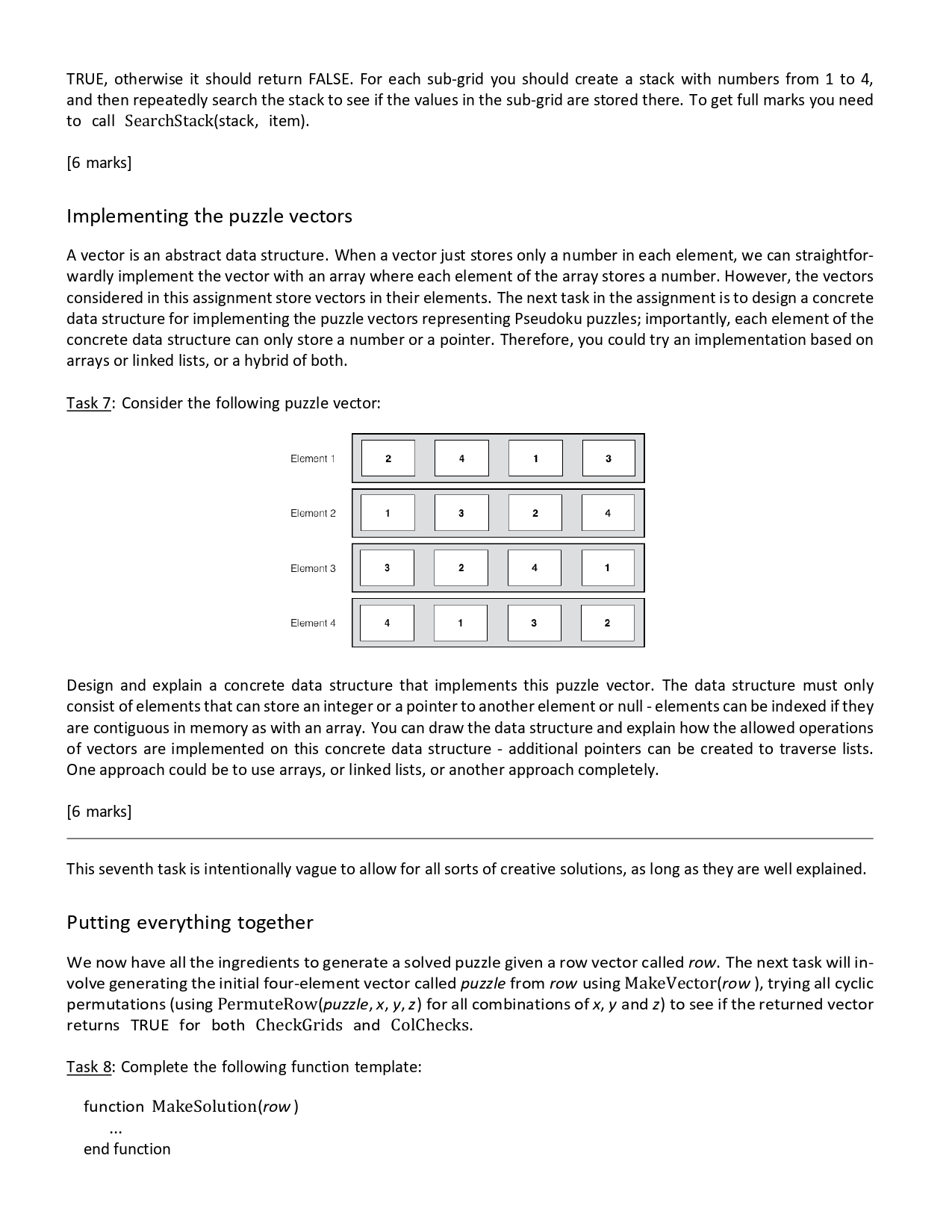
Task 7: Consider the following puzzle vector:
Element 1
Element 2
Element 3
Element 4
end function
2
1
3
4
3
2
Task 8: Complete the following function template:
function MakeSolution (row)
1
2
Design and explain a concrete data structure that implements this puzzle vector. The data structure must only
consist of elements that can store an integer or a pointer to another element or null - elements can be indexed if they
are contiguous in memory as with an array. You can draw the data structure and explain how the allowed operations
of vectors are implemented on this concrete data structure - additional pointers can be created to traverse lists.
One approach could be to use arrays, or linked lists, or another approach completely.
[6 marks]
4
This seventh task is intentionally vague to allow for all sorts of creative solutions, as long as they are well explained.
Putting everything together
We now have all the ingredients to generate a solved puzzle given a row vector called row. The next task will in-
volve generating the initial four-element vector called puzzle from row using Make Vector (row), trying all cyclic
permutations (using PermuteRow(puzzle, x, y, z) for all combinations of x, y and z) to see if the returned vector
returns TRUE for both CheckGrids and ColChecks./nThis function will take the four-element vector row as input, which is the same input for the function MakeVec-
tor. The function should return a solved Pseudoku puzzle such that all column and sub-grid Pseudoku conditions
are satisfied. The function will generate a vector using MakeVector(row), then try cyclic permutations on this
vector using PermuteRow(puzzle, x, y, z) until a set of permutations is found such that all Pseudoku conditions
are satisfied (checked using CheckGrids and ColCheck). To be able to get full marks you should call the
functions MakeVector, PermuteRow, CheckGrids and ColCheck.
[6 marks]
All of the methods above will just produce a solved Pseudoku puzzle. In order to produce a proper Pseudoku puzzle,
numbers will need to be removed from the output of MakeSolution and replaced with a blank character. To
complete the algorithm for generating Pseudoku puzzles, in addition to the input vector row, we have the integer
n, which will stipulate the number of blank entries in the final puzzle.
Task 9: Describe a method for setting values to be blank characters in the elements of the output of MakeSo-
lution. You can describe the method in words, use pseudocode, or use a flowchart. The method should take
the number n as an input parameter and set n values to be blank characters. You do not need to go into great
detail as long as the method makes sense. Maximum word count for the whole task (excluding diagrams): 200 words.
[4 marks]
Task 10: One limitation of the algorithm in this assignment is that rows in the puzzles will only be cyclic permutations
of the initial row and some puzzles are not like this.
Explain how you might modify the algorithm to fix this limitation. Maximum word count for the whole task: 400 words
(excluding figures).
[6 marks]/nTask 2: Complete the following function template:
function PermuteVector(row, p)
if p = 0 then
return row
end if
new Queue q
end function
This function should take a four-element vector called row as an input parameter and return that vector but with
its values cyclically permuted by p elements to the left: p should be a number between 0 and 3 (inclusive). To be
able to get full marks you need to use the queue abstract data structure appropriately as outlined above.
[5 marks]
The function PermuteVector, once completed, will only cyclically permute one vector. The next task is to take
a vector puzzle of the form returned by the function Make Vector, and apply Permute Vector to each of the
elements of puzzle. That is, given vector puzzle and three numbers x, y and z, elements 1, 2 and 3 of puzzle will
be cyclically permuted x, y and z places to the right respectively.
Task 3: Complete the following function template:
function PermuteRows(puzzle, x, y, z)
end function
This function should take a four lement tor called puzzle, which will be of the orm of the output of keVec-
tor as an input parameter, as well as three integers x, y and z. The function will return puzzle but with elements
puzzle[1], puzzle[2] and puzzle[3] cyclically permuted by x, y and z elements respectively to the left: x, y and
z should all be numbers between 0 and 3 (inclusive). To be able to get full marks you should call the function
PermuteVector appropriately. HINT: You do not need to loop over integers x, y and z.
[3 marks]
Checking the Pseudoku conditions
The next step in constructing the algorithm is to write methods to decide if the Pseudoku conditions are satisfied.
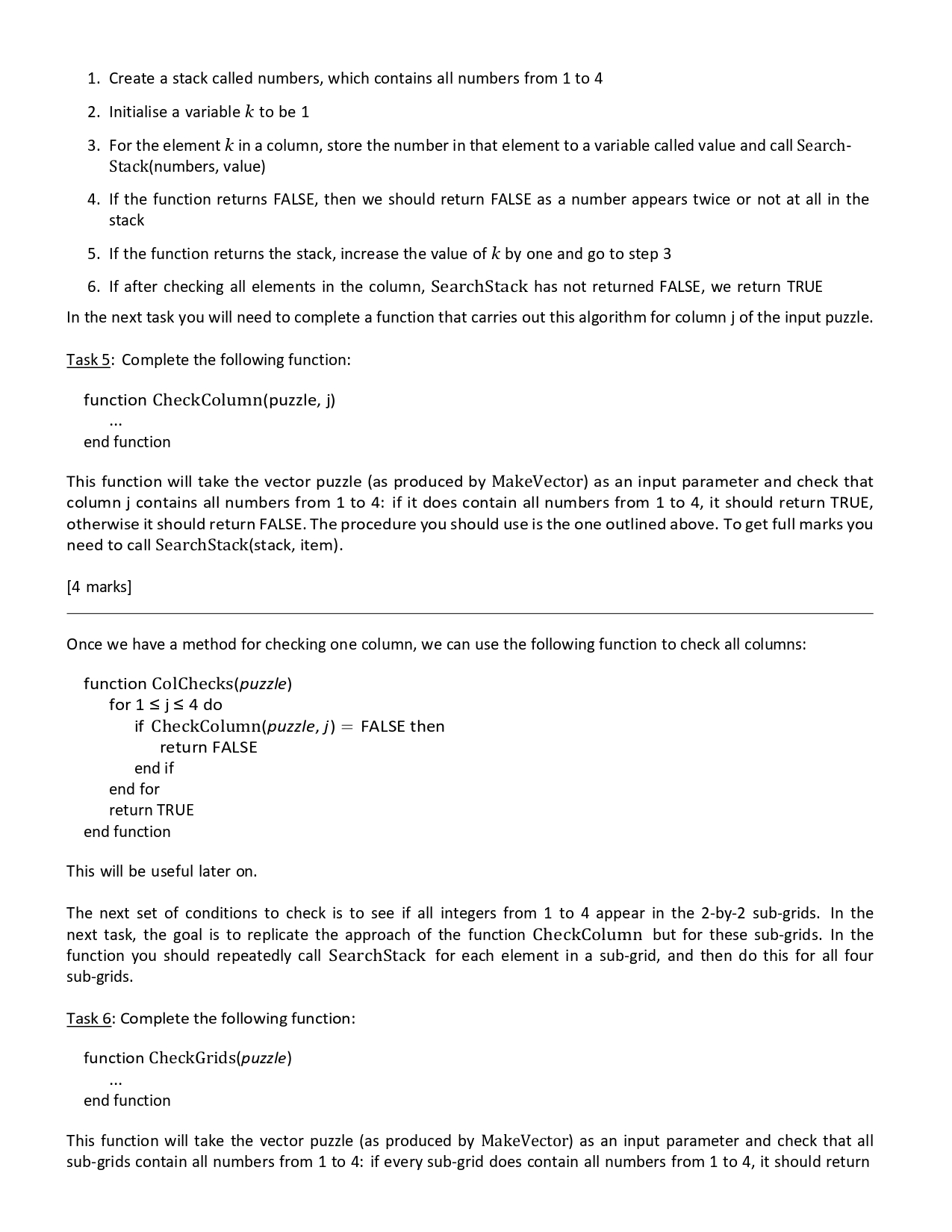
If we start with the output of the function MakeVector(row), then all of the row conditions are satisfied as long
as row is a four-element vector with the numbers 1 to 4 only appearing once. However, the column conditions are
not satisfied: only one number appears in each column (four times). The 2-by-2 sub-grid conditions are also not
satisfied: in each sub-grid only two numbers appear (twice).
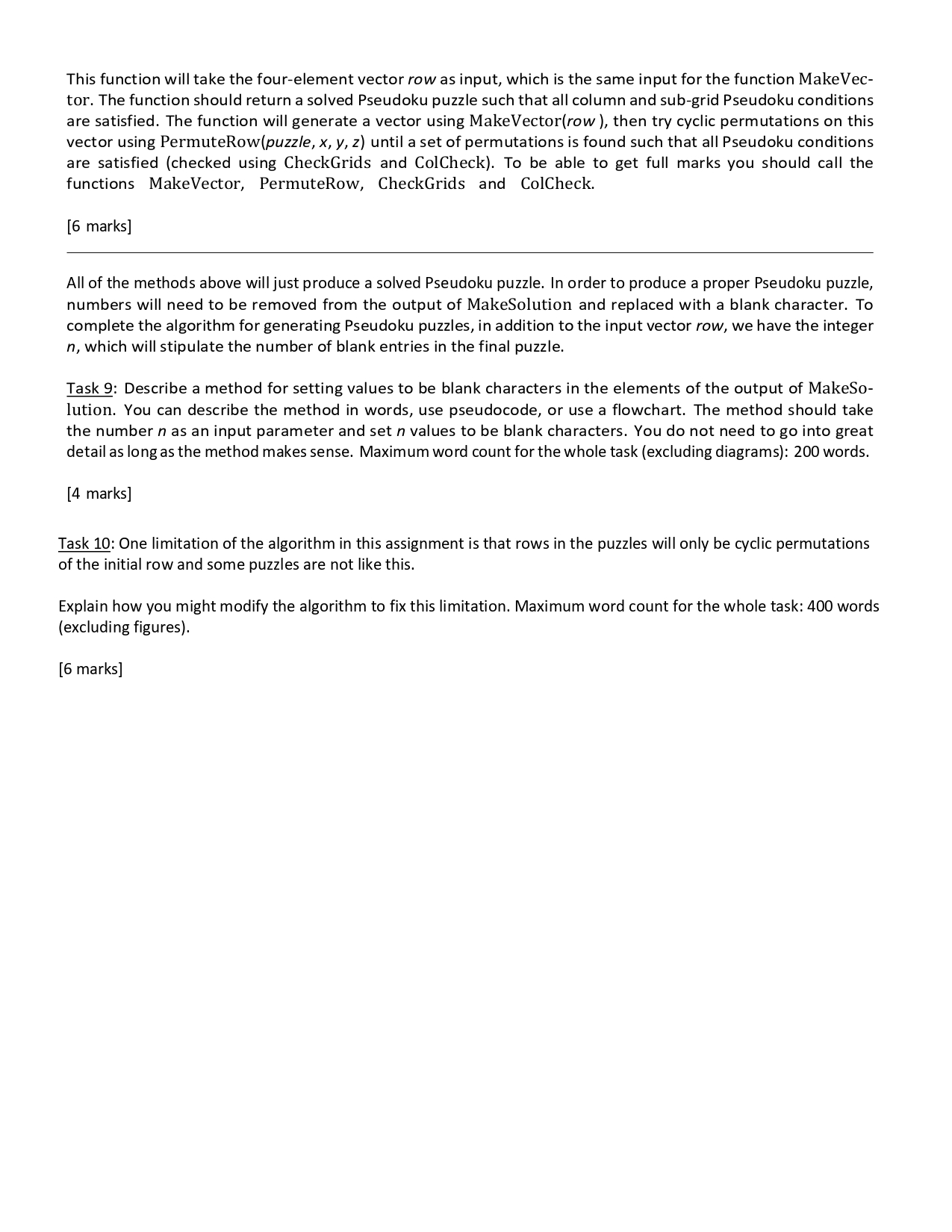
We need a convenient way to refer to elements of the two-dimensional puzzle. We will use a coordinate sys-
tem of (row,col ) for the four-element vector puzzle as produced by MakeVector: row is the number of the
element of puzzle that we care about, and col is the number of the element in puzzle[row ] that we care about.
Consider the following vector:/nElement 1
Element 2
Element 3.
Element 4
end function
2
1
†
Top
2
2
Task 4: Complete the following function:
function SearchStack(stack, item)
2
The coordinates of the element in yellow are (3,2), for example. So to select the value stored there we use the
syntax puzzle[3][2], since we are looking at the second element in puzzle[3]. Using this coordinate system to re-
fer to the 2-by-2 sub-grids, for example, the top-left sub-grid will consist of the elements (1,1), (1,2), (2,1) and (2,2).
You will check the Pseudoku conditions using a stack. In particular, you will start with a stack containing all
numbers from 1 to 4, and then inspect each element in each column (or sub-grid) to see if the number in that
element is stored in the stack: if it is stored in the stack, pop that value from the stack and return the stack;
otherwise, return false. This process will be repeated for every element in a column or sub-grid. If, at the end of
checking every element, the stack is empty then all numbers appear in the the column or sub-grid; if the stack is
not empty, then not all numbers from 1 to 4 appear.
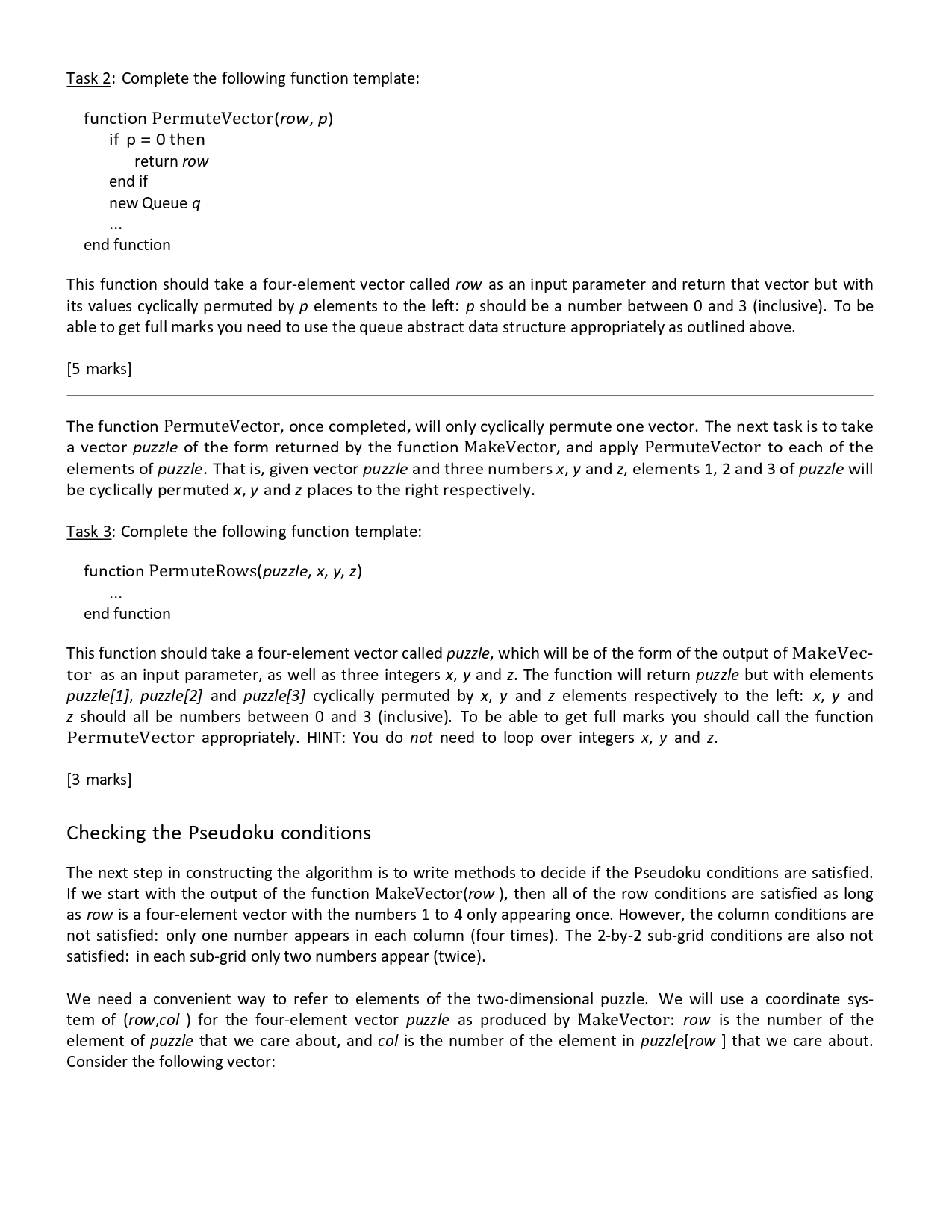
We will complete a function called Search Stack(stack, item) that will search a stack for the value item: if
item is in one of the elements of the stack, we remove that element storing item. Otherwise, the function should
return FALSE Let's demonstrate this with diagram. We have the following stack:
1
2
1
↑
Top
3
3
2
3
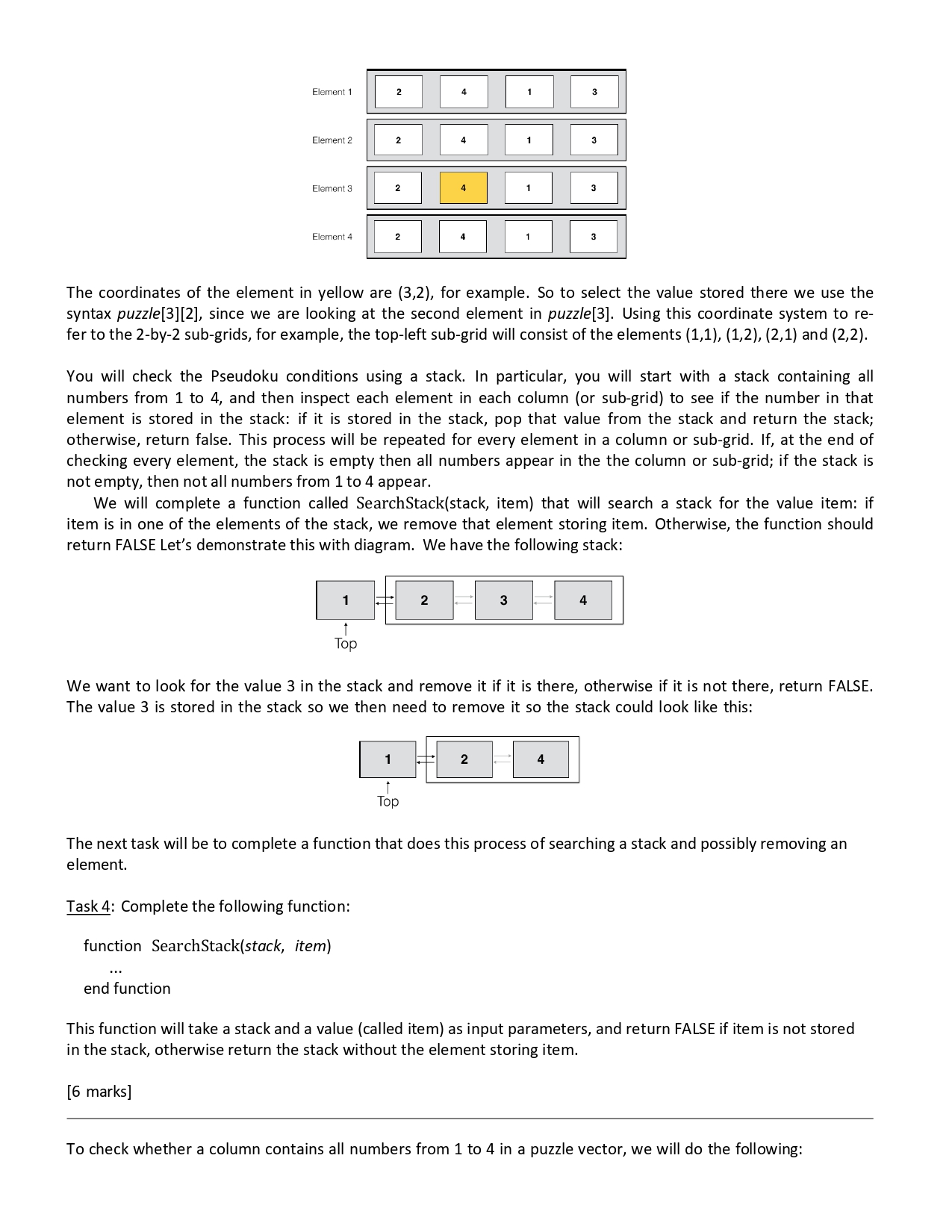
We want to look for the value 3 in the stack and remove it if it is there, otherwise if it is not there, return FALSE.
The value 3 is stored in the stack so we then need to remove it so the stack could look like this:
4
The next task will be to complete a function that does this process of searching a stack and possibly removing an
element.
This function will take a stack and a value (called item) as input parameters, and return FALSE if item is not stored
in the stack, otherwise return the stack without the element storing item.
[6 marks]
To check whether a column contains all numbers from 1 to 4 in a puzzle vector, we will do the following:/n1. Create a stack called numbers, which contains all numbers from 1 to 4
2. Initialise a variable k to be 1
3. For the element k in a column, store the number in that element to a variable called value and call Search-
Stack(numbers, value)
4. If the function returns FALSE, then we should return FALSE as a number appears twice or not at all in the
stack
5. If the function returns the stack, increase the value of k by one and go to step 3
6. If after checking all elements in the column, SearchStack has not returned FALSE, we return TRUE
In the next task you will need to complete a function that carries out this algorithm for column j of the input puzzle.
Task 5: Complete the following function:
function CheckColumn(puzzle, j)
end function
This function will take the vector puzzle (as produced by MakeVector) as an input parameter and check that
column j contains all numbers from 1 to 4: if it does contain all numbers from 1 to 4, it should return TRUE,
otherwise it should return FALSE. The procedure you should use is the one outlined above. To get full marks you
need to call Search Stack(stack, item).
[4 marks]
Once we have a method for checking one column, we can use the following function to check all columns:
function ColChecks (puzzle)
for 1 ≤ j≤ 4 do
if CheckColumn(puzzle, j) = FALSE then
return FALSE
end if
end for
return TRUE
end function
This will be useful later on.
The next set of conditions to check is to see if all integers from 1 to 4 appear in the 2-by-2 sub-grids. In the
next task, the goal is to replicate the approach of the function CheckColumn but for these sub-grids. In the
function you should repeatedly call SearchStack for each element in a sub-grid, and then do this for all four
sub-grids.
Task 6: Complete the following function:
function CheckGrids(puzzle)
end function
This function will take the vector puzzle (as produced by MakeVector) as an input parameter and check that all
sub-grids contain all numbers from 1 to 4: if every sub-grid does contain all numbers from 1 to 4, it should return/nCyclic permutation of row vectors
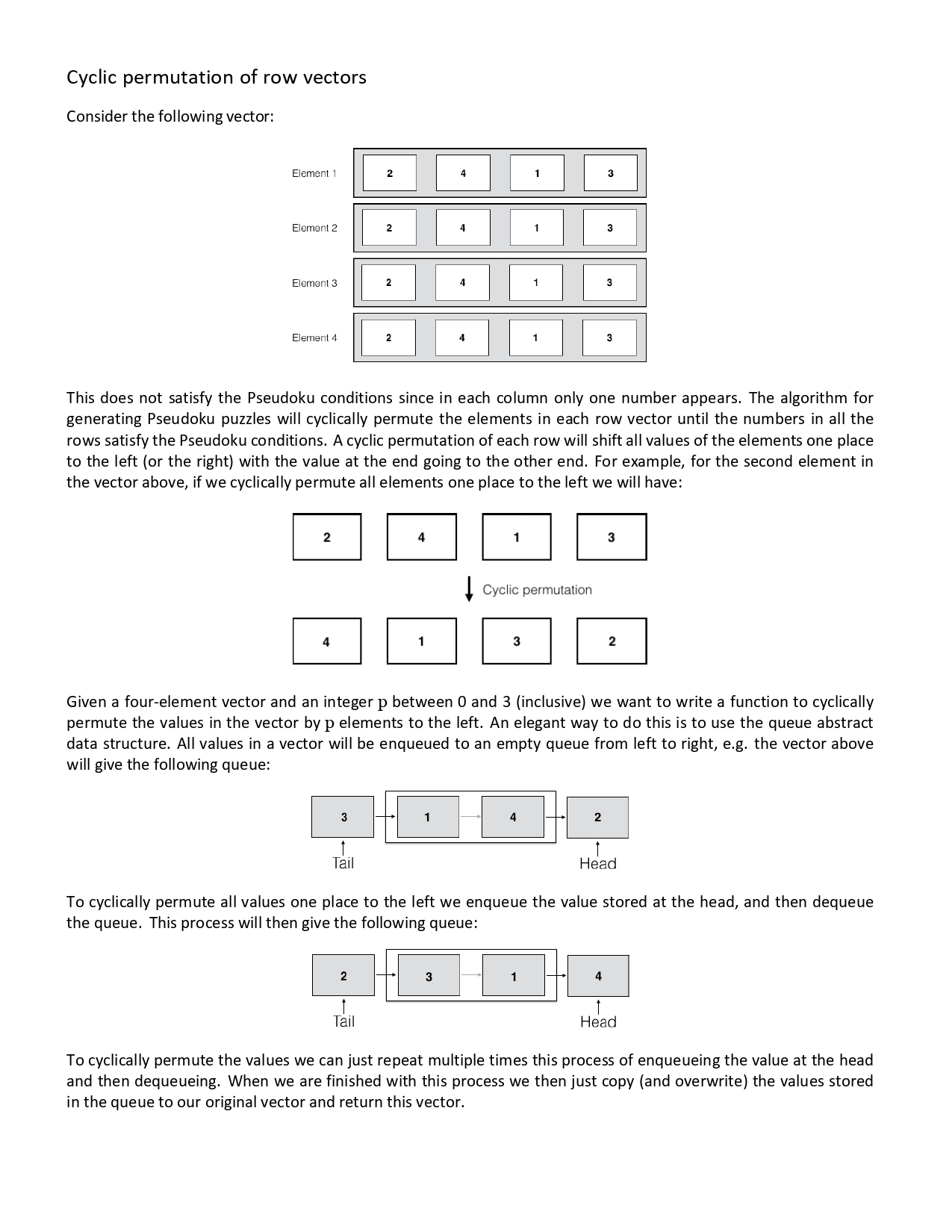
Consider the following vector:
Element 1
Element 2
Element 3
Element 4
2
4
3
Tail
2
2
This does not satisfy the Pseudoku conditions since in each column only one number appears. The algorithm for
generating Pseudoku puzzles will cyclically permute the elements in each row vector until the numbers in all the
rows satisfy the Pseudoku conditions. A cyclic permutation of each row will shift all values of the elements one place
to the left (or the right) with the value at the end going to the other end. For example, for the second element in
the vector above, if we cyclically permute all elements one place to the left we will have:
2
2
↑
Tail
4
1
3
1
3
1
Cyclic permutation
Given a four-element vector and an integer p between 0 and 3 (inclusive) we want to write a function to cyclically
permute the values in the vector by p elements to the left. An elegant way to do this is to use the queue abstract
data structure. All values in a vector will be enqueued to an empty queue from left to right, e.g. the vector above
will give the following queue:
4
3
2
3
3
To cyclically permute all values one place to the left we enqueue the value stored at the head, and then dequeue
the queue. This process will then give the following queue:
4
2
↑
Head
Head
To cyclically permute the values we can just repeat multiple times this process of enqueueing the value at the head
and then dequeueing. When we are finished with this process we then just copy (and overwrite) the values stored
in the queue to our original vector and return this vector./n2. every column has all integers from 1 to 4 (with each appearing only once)
3. every 2-by-2 sub-grid, or block (with bold outlines around them going from top-left to bottom-right) has all
integers from 1 to 4
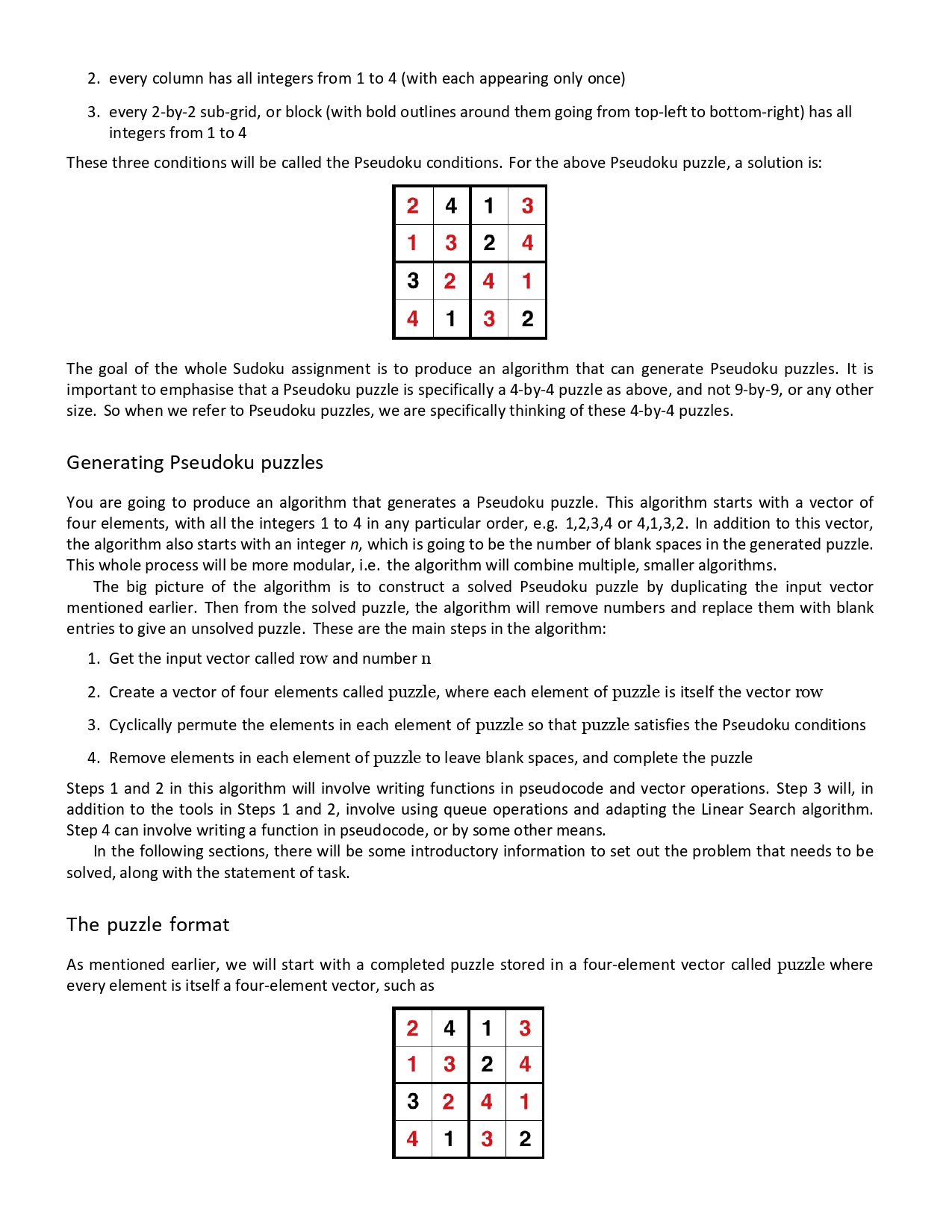
These three conditions will be called the Pseudoku conditions. For the above Pseudoku puzzle, a solution is:
2
1
3
4 1 3
3 2 4
2 4 1
1 3 2
The goal of the whole Sudoku assignment is to produce an algorithm that can generate Pseudoku puzzles. It is
important to emphasise that a Pseudoku puzzle is specifically a 4-by-4 puzzle as above, and not 9-by-9, or any other
size. So when we refer to Pseudoku puzzles, we are specifically thinking of these 4-by-4 puzzles.
Generating Pseudoku puzzles
You are going to produce an algorithm that generates a Pseudoku puzzle. This algorithm starts with a vector of
four elements, with all the integers 1 to 4 in any particular order, e.g. 1,2,3,4 or 4,1,3,2. In addition to this vector,
the algorithm also starts with an integer n, which is going to be the number of blank spaces in the generated puzzle.
This whole process will be more modular, i.e. the algorithm will combine multiple, smaller algorithms.
The big picture of the algorithm is to construct a solved Pseudoku puzzle by duplicating the input vector
mentioned earlier. Then from the solved puzzle, the algorithm will remove numbers and replace them with blank
entries to give an unsolved puzzle. These are the main steps in the algorithm:
1. Get the input vector called row and number n
2. Create a vector of four elements called puzzle, where each element of puzzle is itself the vector row
3. Cyclically permute the elements in each element of puzzle so that puzzle satisfies the Pseudoku conditions
4. Remove elements in each element of puzzle to leave blank spaces, and complete the puzzle
Steps 1 and 2 in this algorithm will involve writing functions in pseudocode and vector operations. Step 3 will, in
addition to the tools in Steps 1 and 2, involve using queue operations and adapting the Linear Search algorithm.
Step 4 can involve writing a function in pseudocode, or by some other means.
In the following sections, there will be some introductory information to set out the problem that needs to be
solved, along with the statement of task.
The puzzle format
As mentioned earlier, we will start with a completed puzzle stored in a four-element vector called puzzle where
every element is itself a four-element vector, such as
2413
1 3
2 4
32 4 1
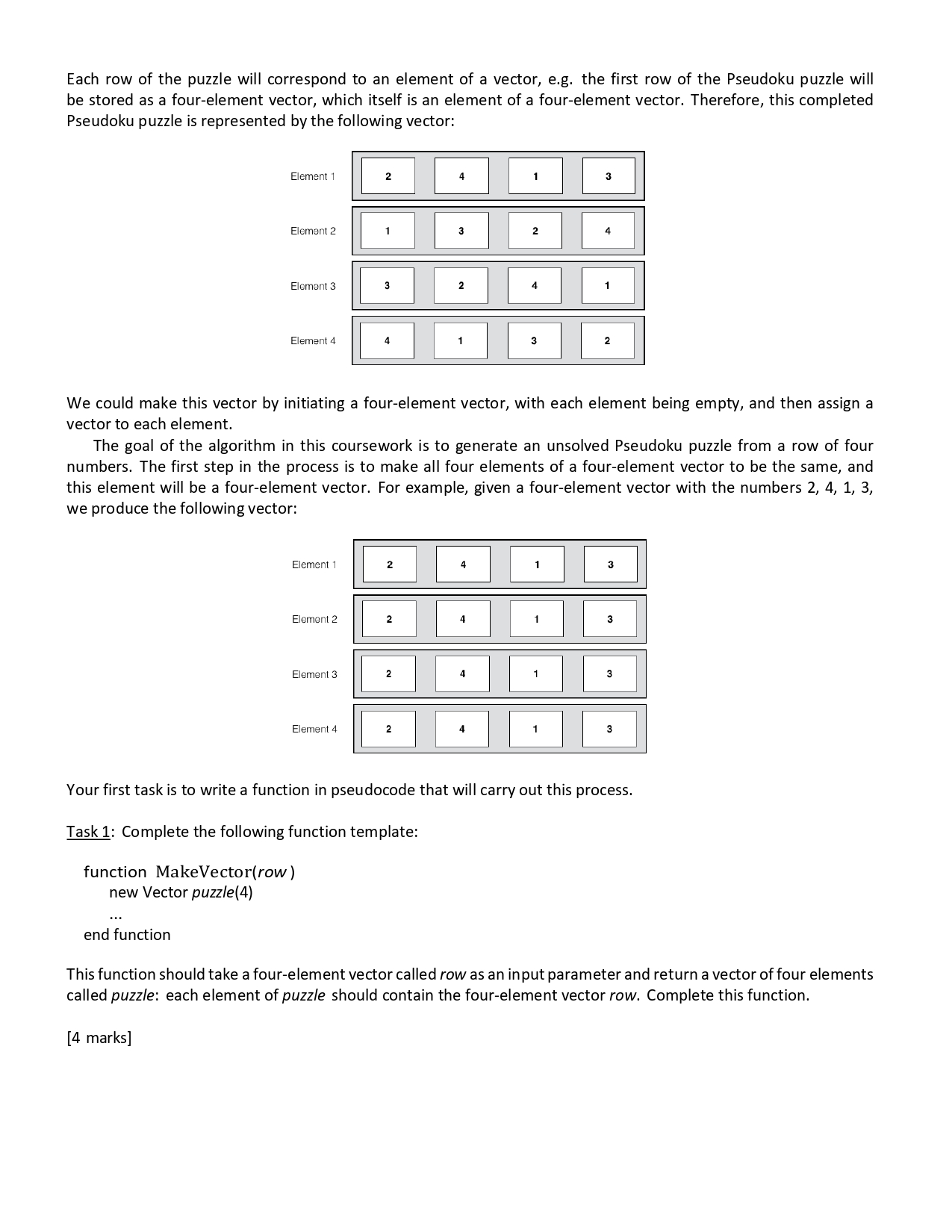
4 13 2/nEach row of the puzzle will correspond to an element of a vector, e.g. the first row of the Pseudoku puzzle will
be stored as a four-element vector, which itself is an element of a four-element vector. Therefore, this completed
Pseudoku puzzle is represented by the following vector:
Element 1
Element 2
end function
Element 3
Element 4
[4 marks]
Element 1
Element 2
2
Element 3
1
We could make this vector by initiating a four-element vector, with each element being empty, and then assign a
vector to each element.
Element 4
4
The goal of the algorithm in this coursework is to generate an unsolved Pseudoku puzzle from a row of four
numbers. The first step in the process is to make all four elements of a four-element vector to be the same, and
this element will be a four-element vector. For example, given a four-element vector with the numbers 2, 4, 1, 3,
we produce the following vector:
2
3
2
2
2
1
2
4
1
1
Your first task is to write a function in pseudocode that will carry out this process.
Task 1: Complete the following function template:
function MakeVector(row)
new Vector puzzle(4)
3
This function should take a four-element vector called row as an input parameter and return a vector of four elements
called puzzle: each element of puzzle should contain the four-element vector row. Complete this function./nCoursework Assignment: Sudoku assignment
Algorithms and Data Structure |
The 10 tasks in this assignment make up the Sudoku coursework assignment. The tasks in this assignment consist,
in the main, of functions or lines of code to be written in pseudocode. Because your solutions should be written in
pseudocode, marks will not be deducted for small syntax errors as long as the pseudocode can be understood by
a human. Having said that, it is highly recommended that you use the pseudocode conventions given in this module.
There are 50 marks available in total for this assignment. Submit your work as a pdf file - You may receive
no marks at all if your work is not in pdf format!
Background: Sudoku and Pseudoku
A Sudoku puzzle consists of 9-by-9 grid of squares, some of them blank, some of them having integers from 1 to 9.
A typical Sudoku puzzle will then look something like this:
3
5
8
1 2 3
9
3
9 3 6
1 7
⠀⠀
1
5
7 2
3 4 2
6
9 8 2
8
7
5
6
8 9 7
4 2 1
4 1
2
1 8 6
7
2
To solve this puzzle, all the squares must be filled with numbers from 1 to 9 such that the following are satisfied:
1. every row has all integers from 1 to 9 (with each appearing only once)
2. every column has all integers from 1 to 9 (with each appearing only once)
3. every 3-by-3 sub-grid, or block (with bold outlines around them going from top-left to bottom-right) has all
integers from 1 to 9
3
In this coursework, we won't be generating and solving Sudoku puzzles exactly, but a simplified version of Sudoku
puzzles, which I will call Pseudoku puzzles - pronounced the same. In a Pseudoku puzzle, we now have a 4-by-4
grid of squares, some of them blank, some of them having integers from 1 to 4. A typical Pseudoku puzzle will look
like this:
2
Now to solve this puzzle, all the squares must be filled with numbers from 1 to 4 such that the following are satisfied:
1. every row has all integers from 1 to 4 (with each appearing only once)