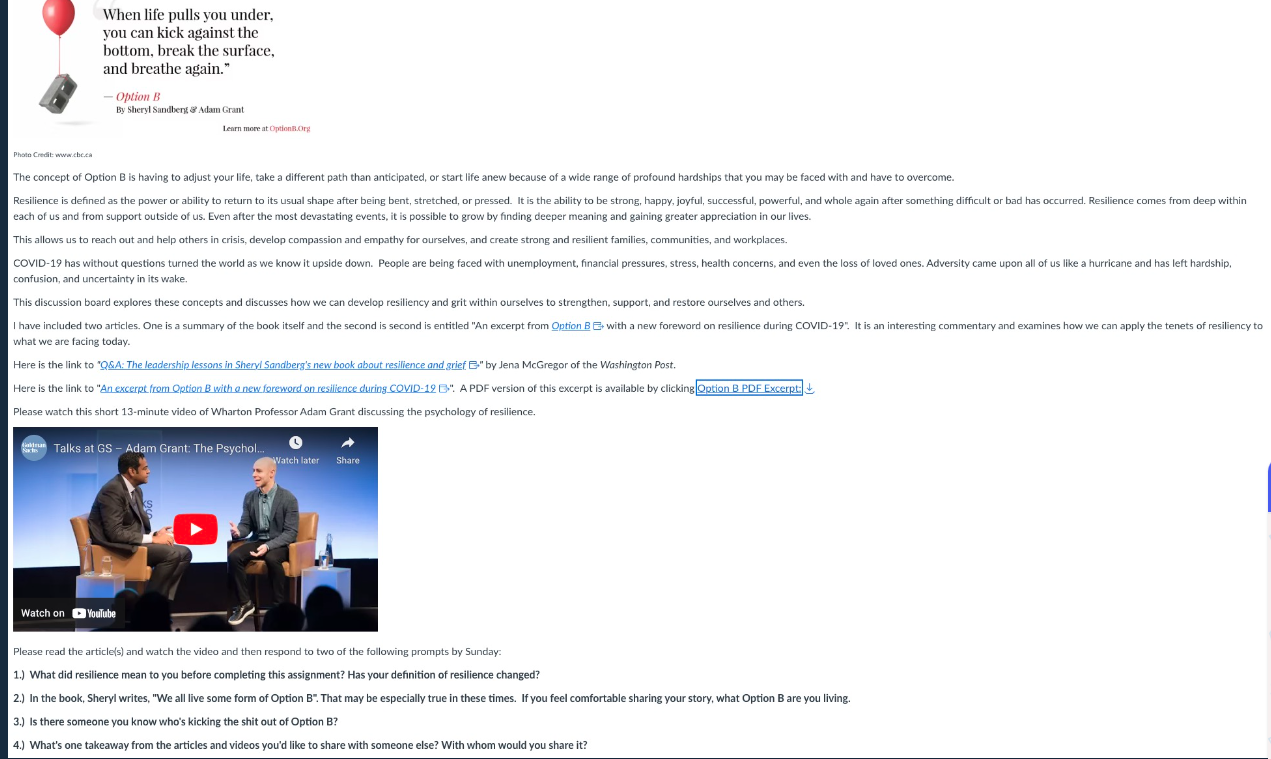
When life pulls you under,
you can kick against the
bottom, break the surface,
and breathe again."
-Option B
By Sheryl Sandberg & Adam Grant.
Learn more at Option.Org
Photo Credit: www.cbc.ca
The concept of Option B is having to adjust your life, take a different path than anticipated, or start life anew because of a wide range of profound hardships that you may be faced with and have to overcome.
Resilience is defined as the power or ability to return to its usual shape after being bent, stretched, or pressed. It is the ability to be strong, happy, joyful, successful, powerful, and whole again after something difficult or bad has occurred. Resilience comes from deep within
each of us and from support outside of us. Even after the most devastating events, it is possible to grow by finding deeper meaning and gaining greater appreciation in our lives.
This allows us to reach out and help others in crisis, develop compassion and empathy for ourselves, and create strong and resilient families, communities, and workplaces.
COVID-19 has without questions turned the world as we know it upside down. People are being faced with unemployment, financial pressures, stress, health concerns, and even the loss of loved ones. Adversity came upon all of us like a hurricane and has left hardship,
confusion, and uncertainty in its wake.
This discussion board explores these concepts and discusses how we can develop resiliency and grit within ourselves to strengthen, support, and restore ourselves and others.
I have included two articles. One is a summary of the book itself and the second is second is entitled "An excerpt from Option BE with a new foreword on resilience during COVID-19". It is an interesting commentary and examines how we can apply the tenets of resiliency to
what we are facing today.
Here is the link to "Q&A: The leadership lessons in Sheryl Sandberg's new book about resilience and grief " by Jena McGregor of the Washington Post.
Here is the link to "An excerpt from Option B with a new foreword on resilience during COVID-19B". A PDF version of this excerpt is available by clicking Option B PDF Excerpt:
Please watch this short 13-minute video of Wharton Professor Adam Grant discussing the psychology of resilience.
Sachs Talks at GS - Adam Grant: The Psychol.
Watch on YouTube
Watch later Share
Please read the article(s) and watch the video and then respond to two of the following prompts by Sunday:
1.) What did resilience mean to you before completing this assignment? Has your definition of resilience changed?
2.) In the book, Sheryl writes, "We all live some form of Option B". That may be especially true in these times. If you feel comfortable sharing your story, what Option B are you living.
3.) Is there someone you know who's kicking the shit out of Option B?
4.) What's one takeaway from the articles and videos you'd like to share with someone else? With whom would you share it?/nTHE MAN IN THE ARENA
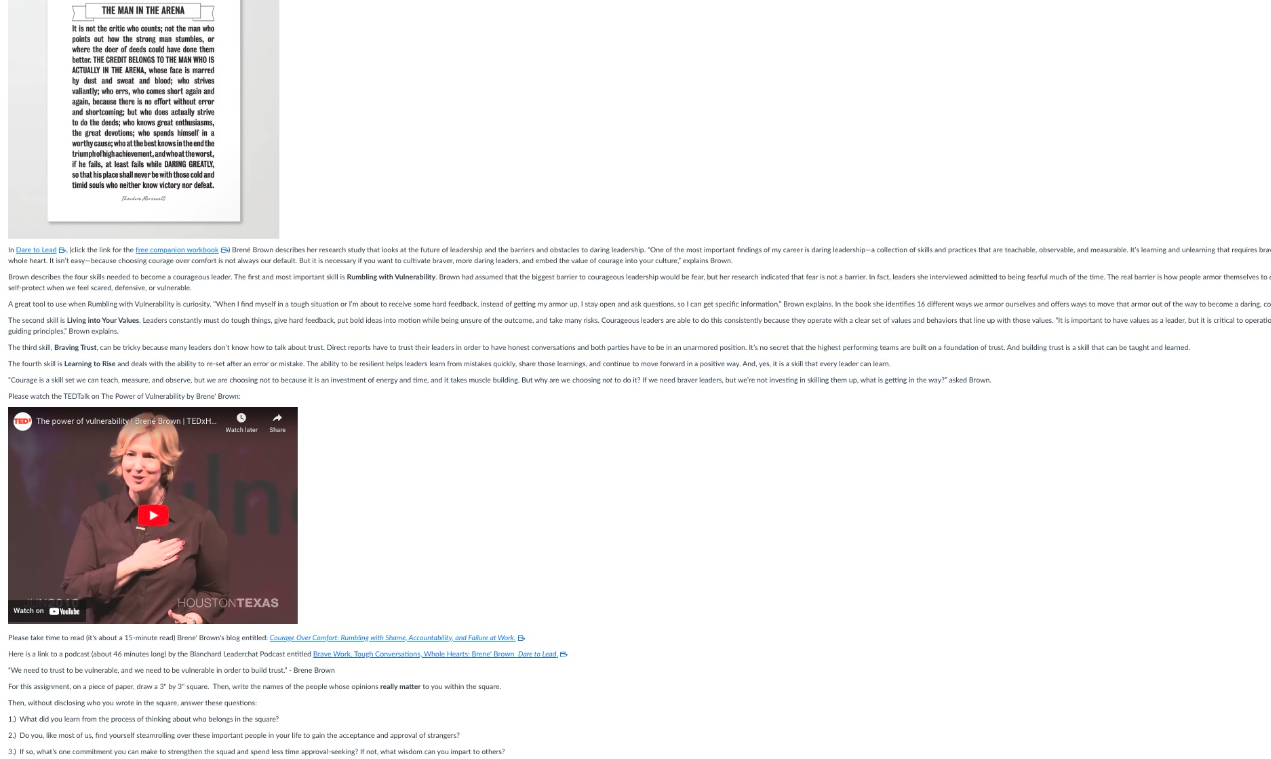
It is not the critic who counts; not the man who
points out how the strong man stumbles, or
where the doer of deeds could have done them
better. THE CREDIT BELONGS TO THE MAN WHO IS
ACTUALLY IN THE ARENA, whose face is marred
by dust and sweat and blood; who strives
valiantly; who errs, who comes short again and
again, because there is no effort without error
and shortcoming; but who does actually strive
to do the deeds; who knows great enthusiasms,
the great devotions; who spends himself in a
worthy cause who at the best knows in the end the
triumph of high achievement, and who at the worst,
if he fails, at least fails while DARING GREATLY,
so that his place shall never be with those cold and
timid souls who neither know victory nor defeat.
In Dare to Lead B. click the link for the free companion workbook B) Brené Brown describes her research study that looks at the future of leadership and the barriers and obstacles to daring leadership. "One of the most important findings of my career is daring leadership-a collection of skills and practices that are teachable, observable, and measurable. It's leaming and unlearning that requires bra
whole heart. It isn't easy-because choosing courage over comfort is not always our default. But it is necessary if you want to cultivate braver, more daring leaders, and embed the value of courage into your culture," explains Brown.
Brown describes the four skills needed to become a courageous leader. The first and most important skill is Rumbling with Vulnerability. Brown had assumed that the biggest barrier to courageous leadership would be fear, but her research indicated that fear is not a barrier. In fact, leaders she interviewed admitted to being fearful much of the time. The real barrier is how people armor themselves to c
self-protect when we feel scared, defensive, or vulnerable
A great tool to use when Rumbling with Vulnerability is curiosity. "When I find myself in a tough situation or I'm about to receive some hard feedback, instead of getting my armor up, I stay open and ask questions, so I can get specific information Brown explains. In the book she identifies 16 different ways we armor ourselves and offers ways to move that armor out of the way to become a daring, co
The second skill is Living Into Your Values. Leaders constantly must do tough things, give hard feedback, put bold ideas into motion while being unsure of the outcome, and take many risks. Courageous leaders are able to do this consistently because they operate with a clear set of values and behaviors that line up with those values. "It is important to have values as a leader, but it is critical to operatio
guiding principles, Brown explains
The third skill, Braving Trust, can be tricky because many leaders don't know how to talk about trust. Direct reports have to trust their leaders in order to have honest conversations and both parties have to be in an unarmored position. It's no secret that the highest performing teams are built on a foundation of trust. And building trust is a skill that can be taught and learned.
The fourth skill is Learning to Rise and deals with the ability to re-set after an error or mistake. The ability to be resilient helps leaders leam from mistakes quickly, share those learnings, and continue to move forward in a positive way. And, yes, it is a skill that every leader can leam.
"Courage is a skill set we can teach, measure, and observe, but we are choosing not to because it is an investment of energy and time, and it takes muscle building. But why are we choosing not to do it? If we need braver leaders, but we're not investing in skilling them up, what is getting in the way?" asked Brown.
Please watch the TEDTalk on The Power of Vulnerability by Brene' Brown:
TED The power of vulnerability Brene Brown | TEDXH..
Mann
Watch on Webe
·
Watch later Share
HOUSTONTEXAS
Please take time to read (it's about a 15-minute read) Brene' Brown's blog entitled: Courage Over Comfort: Rumbling with Shame, Accountability, and Failure at Work.B
Here is a link to a podcast (about 46 minutes long) by the Blanchard Leaderchat Podcast entitled Brave Work. Tough Conversations, Whole Hearts: Brene Brown Dare to Lead, B
"We need to trust to be vulnerable, and we need to be vulnerable in order to build trust." - Brene Brown
For this assignment, on a piece of paper, draw a 3" by 3" square. Then, write the names of the people whose opinions really matter to you within the square.
Then, without disclosing who you wrote in the square, answer these questions:
1) What did you learn from the process of thinking about who belongs in the square?
2.) Do you, like most of us, find yourself steamrolling over these important people in your life to gain the acceptance and approval of strangers?
3.) If so, what's one commitment you can make to strengthen the squad and spend less time approval-seeking? If not, what wisdom can you impart to others?